Research Articles
BPC-157 Reconstitution Protocol for Research: Laboratory Best Practices

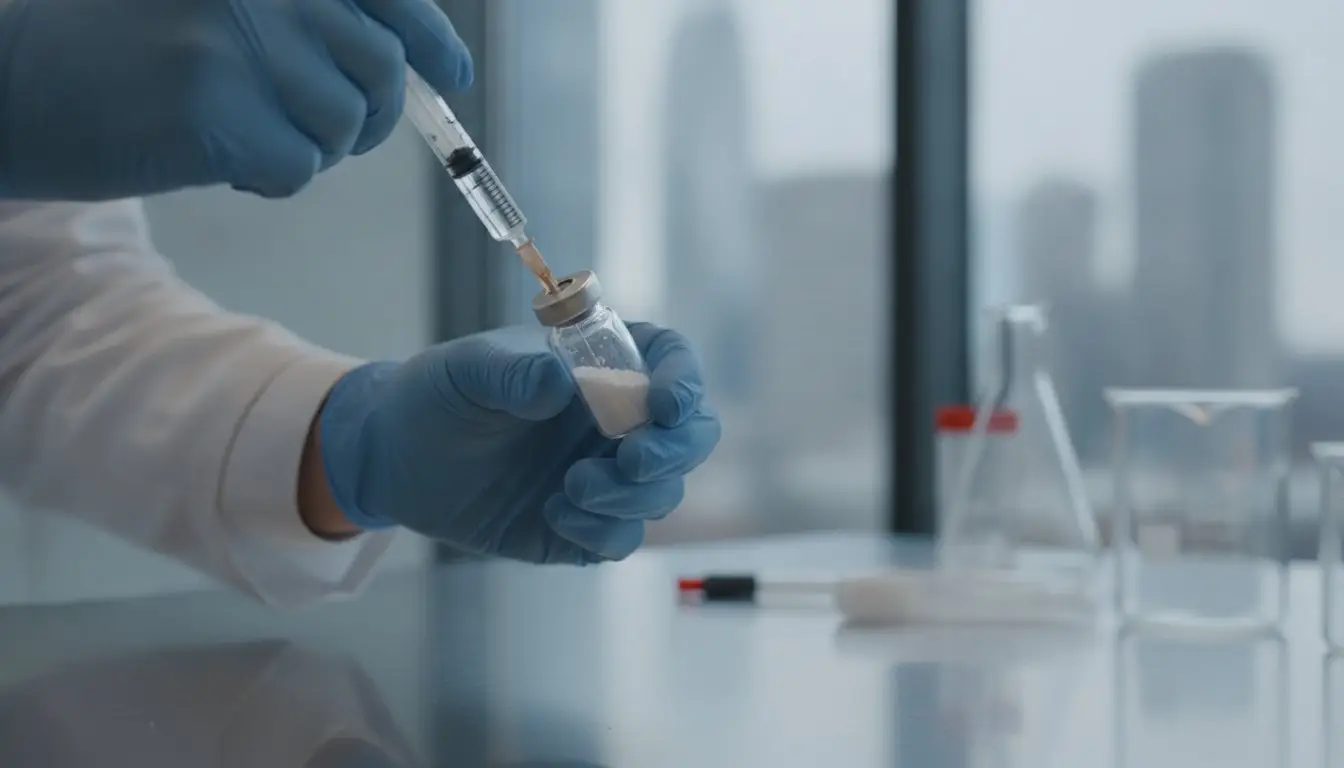
Inconsistent molarity in a single batch can invalidate months of laboratory data, turning a controlled experiment into a series of unrepeatable anomalies. Precision in the lab begins long before the first observation. It starts at the bench during the delicate transition from lyophilized powder to a stable solution. Establishing a standardized BPC-157 reconstitution protocol for research is essential for maintaining the structural integrity of the peptide. At Solara Compounds, we recognize that your data depends on the stability and purity of your materials. All products mentioned are for laboratory research only and are not for human or animal consumption.
You likely already know that improper handling, such as vigorous shaking or using incompatible solvents, leads to rapid peptide degradation. This guide provides a technical framework for precise chemical reconstitution and molarity calculation. We will detail the exact steps for solvent integration, stability management, and the importance of verifying peptide identity via a Certificate of Analysis (COA) from solaracompounds.com. By following these peer-review standards, you can ensure accurate concentration for precise titration and repeatable results in every experimental batch.
Key Takeaways
- Understand the molecular properties of the 15-amino acid sequence to ensure experimental precision and signaling accuracy.
- Learn to select the correct analytical solvents, such as BAC Water, to maintain peptide stability throughout the duration of your study.
- Implement a repeatable BPC-157 reconstitution protocol for research that uses precise volume calculations to achieve consistent molarity.
- Establish laboratory best practices for storage and handling to prevent premature degradation of the pentadecapeptide chain.
- Review the necessity of lot-specific COAs from solaracompounds.com to verify the purity and identity of your laboratory reagents.
Defining BPC-157 and its Molecular Properties for Research
BPC-157 (Body Protection Compound 157) is a synthetic pentadecapeptide consisting of a 15-amino acid sequence. It’s derived from a protective protein naturally occurring in human gastric juice. In a laboratory setting, the primary focus is the Gly-Pro-Pro-Gly-Lys-Pro-Ala-Asp-Asp-Ala-Gly-Leu-Val chain. This specific sequence is the subject of extensive research regarding its role in regenerative signaling pathways and biochemical modeling. Because this compound is a partial sequence of a larger protein, its stability and behavior in solution are highly dependent on its environment and the precision of its preparation.
Precision in an experimental setting requires an exact understanding of molecular mass. BPC-157 has a molecular weight of approximately 1419.5 g/mol. This specific value is essential for any BPC-157 reconstitution protocol for research that aims for high-fidelity molarity calculations. When researchers prepare solutions for titration or cellular assays, using the correct molecular mass ensures that the concentration is identical across every trial. It’s important to remember that this compound is intended strictly for laboratory research and is not for human or animal consumption.
Research Use Only (RUO) Classification
Maintaining RUO status is critical for institutional compliance and the overall integrity of scientific data. This classification separates research-grade reagents from clinical or pharmaceutical products. Laboratory buyers must ensure that materials used in biochemical modeling are sourced from suppliers that prioritize these standards. Solara Compounds is committed to providing high-purity materials specifically for in vitro research. By adhering to RUO guidelines, labs can avoid the legal and ethical complications associated with mislabeled or diverted medical substances. This focus on compliance ensures that the data generated is suitable for peer-reviewed publication.
Lyophilization and Purity Standards
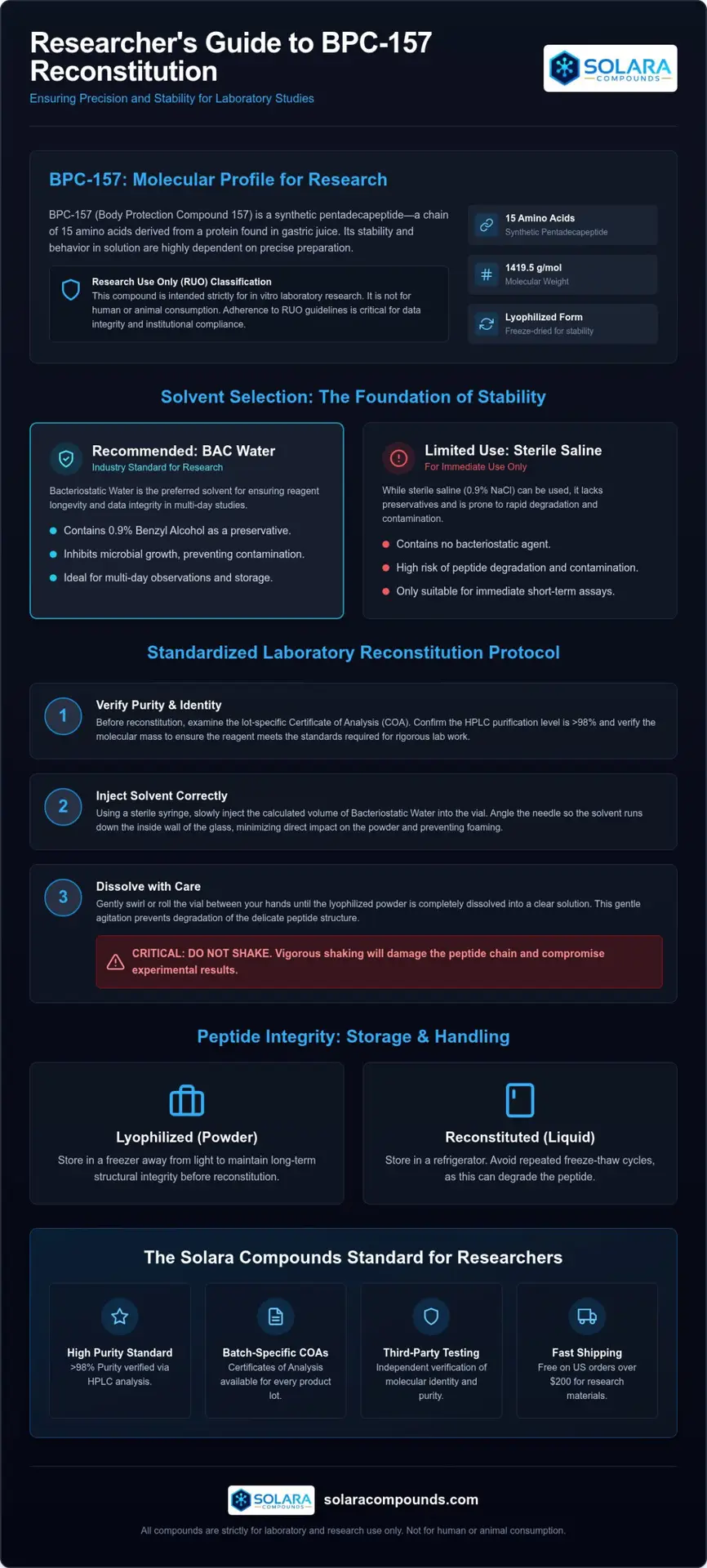
The primary structure of a peptide is delicate. Lyophilization, or freeze-drying, is the standard method for preserving this structure during shipping and long-term storage. This process removes water through sublimation, which prevents the hydrolysis that would otherwise degrade the peptide chain. Establishing a standardized BPC-157 reconstitution protocol for research is the first step toward achieving repeatable results from these lyophilized vials. At solaracompounds.com, we target HPLC purification levels of >98% to ensure that experimental outcomes are not influenced by residual contaminants or synthesis byproducts. Before beginning any work, researchers should examine the batch-specific COA to confirm the identity and purity of the lot. This step verifies the molecular mass and ensures the reagent meets the high standards required for rigorous laboratory work.
Selecting Analytical Solvents for BPC-157 Reconstitution
The stability of the BPC-157 pentadecapeptide sequence in a liquid state depends heavily on the chemical properties of the chosen solvent. Researchers must select a diluent that preserves the peptide’s primary structure while preventing microbial proliferation during the observation period. Establishing a precise BPC-157 reconstitution protocol for research begins with identifying the appropriate analytical-grade solvent for the specific experimental model. It is essential to remember that BPC-157 is strictly for laboratory research and is not for human or animal consumption. From a regulatory and ethical standpoint, its inclusion on the WADA Prohibited List under the S0 category highlights the necessity for strictly controlled institutional use and documentation.
While sterile saline (0.9% NaCl) is occasionally used for immediate biochemical assays or short-term modeling, it lacks the preservative qualities required for multi-day studies. Saline solutions are prone to rapid degradation if not used within a very narrow window. For most laboratory applications, a bacteriostatic agent is the preferred choice to ensure the longevity of the reagent and the integrity of the resulting data.
Bacteriostatic Water (10ml) for Research
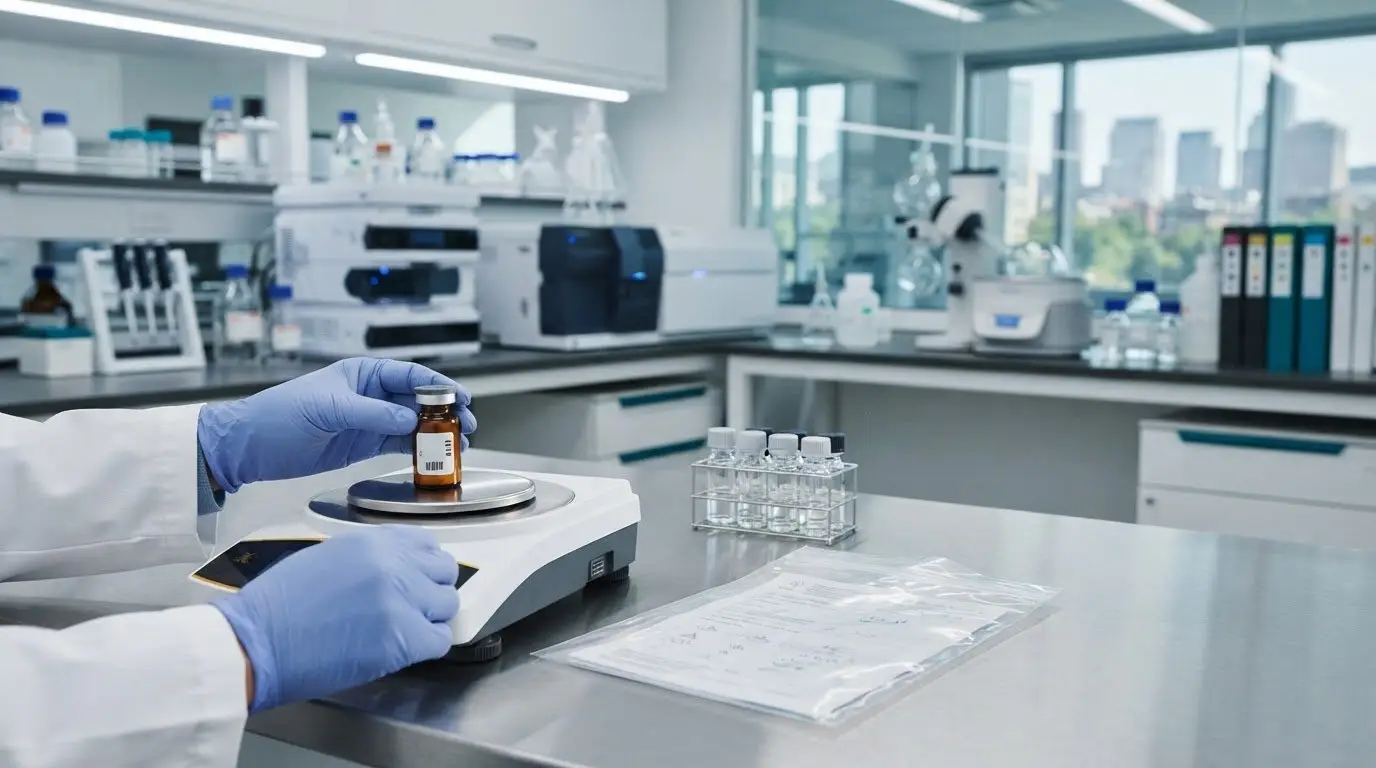
The industry standard for institutional investigative work is Bacteriostatic Water. This solvent contains 0.9% benzyl alcohol, which acts as a preservative by inhibiting the growth of bacteria that could otherwise contaminate the vial. Solara Compounds provides analytical-grade BAC Water (10ml) specifically for these laboratory requirements. Using this solvent allows researchers to maintain reagent purity over several weeks when stored under proper refrigeration. Proper handling involves wiping the septum with a sterile alcohol swab before every withdrawal to prevent introducing environmental contaminants into the sterile field of the vial.
Solubility Metrics in Aqueous Solutions
BPC-157 demonstrates high solubility in aqueous environments, but the pH of the solvent can significantly impact sequence longevity. Peptides generally maintain optimal stability when the solution remains near a neutral pH. Extreme acidity or alkalinity can lead to deamidation or peptide cleavage, which alters the molecular identity of the compound. Researchers should avoid organic solvents like DMSO or high-concentration ethanol unless the specific assay requires it. These substances can denature the peptide or interfere with delicate cellular assays, leading to skewed results.
Temperature also plays a role in the initial dissolution rate. Allowing the lyophilized vial and the solvent to reach room temperature before mixing ensures a smoother transition into solution. If you are preparing for a new phase of investigative work, you can shop research peptides at solaracompounds.com to ensure you are starting with HPLC-verified materials. Maintaining these strict solvent standards ensures that your BPC-157 reconstitution protocol for research yields repeatable, high-fidelity data.
Step-by-Step Laboratory Reconstitution Protocol for BPC-157
Precision in the lab relies on repeatability. A standardized BPC-157 reconstitution protocol for research ensures that every vial is handled with the same level of care, protecting the integrity of your data. All products from Solara Compounds are strictly for laboratory research only and are not for human or animal consumption. Reconstitution should occur in a controlled, sterile environment, ideally an ISO-standard cleanroom or under a laminar flow hood. This prevents environmental contaminants from compromising the reagent during the transition from powder to solution.
Before beginning, ensure all surfaces are sanitized and that you have analytical-grade solvents ready. At solaracompounds.com, we emphasize that the quality of the preparation is just as important as the quality of the peptide itself. Handling these materials requires a methodical approach that prioritizes chemical stability over speed.
Precision Calculation for Molar Concentrations
Determining the correct concentration is the foundation of accurate titration in biochemical modeling. The formula is straightforward: divide the total mass of the peptide by the volume of the diluent. For a vial of BPC-157 10mg, adding 2ml of BAC water results in a final concentration of 5mg/ml. Researchers must also account for displacement volume. In high-concentration solutions, the lyophilized powder itself occupies a small amount of space. This can slightly alter the final concentration if you don’t factor it into the total fluid volume. Maintaining these precise calculations ensures that your in vitro models are based on consistent, verifiable data.
Physical Handling to Prevent Sequence Degradation
The peptide bonds in the BPC-157 sequence are sensitive to high-shear mechanical stress. When you introduce the solvent, don’t aim the stream directly at the lyophilized powder. Instead, let the diluent trickle slowly down the inside wall of the vial. Many vials are vacuum-sealed, which can pull the solvent in aggressively. Venting the vial with a sterile instrument before introduction helps manage this pressure and prevents splashing, which can cause premature degradation of the peptide bonds.
Once the solvent is added, utilize gentle swirling. Mechanical agitation, such as vigorous shaking, causes fragmentation of the peptide chain and renders the batch useless for research. You’ll know the process is complete when the solution reaches the “clear solution” endpoint. This means the powder has fully dissolved without any visible particulates or cloudiness. If the solution remains turbid, it hasn’t reached full dissolution. Consistency in this BPC-157 reconstitution protocol for research is what separates professional-grade laboratory work from inconsistent experimental results.
Stability, Storage, and Handling of BPC-157 Aqueous Solutions
The longevity of a peptide is defined by its environment. While lyophilized BPC-157 remains stable for extended periods when stored at -20°C or -80°C, the transition to an aqueous state initiates a finite degradation window. Protecting the structural integrity of the pentadecapeptide requires strict adherence to environmental controls. UV light exposure and moisture infiltration are primary catalysts for peptide breakdown. Researchers should store vials in dark environments and ensure that seals remain airtight to prevent oxidation. All materials are for laboratory research only and are not for human or animal consumption.
Following a standardized BPC-157 reconstitution protocol for research is only half the battle. Once the peptide is in solution, its secondary structure becomes vulnerable to thermal fluctuations. Repeated freeze-thaw cycles are particularly damaging; the mechanical stress of ice crystal formation can shear the peptide bonds. This leads to sequence fragmentation, which fundamentally alters the reagent’s behavior in biochemical assays. To ensure your study remains viable, shop research peptides at solaracompounds.com and implement a strict aliquoting strategy immediately after reconstitution.
Temperature Management in Laboratory Settings
Active investigative use requires maintaining a consistent temperature between 2°C and 8°C. Refrigeration slows down the natural kinetic energy that drives peptide degradation. Exposure to room temperature should be strictly limited to the duration of the experiment. Effective lab inventory management involves documenting the lot-number traceability and the exact reconstitution date on every vial. This documentation allows for precise tracking of the reagent’s shelf life and ensures that expired materials don’t compromise your data sets. Solara Compounds provides high-purity materials that require these professional handling standards to maintain their HPLC-verified status.
Sequence Integrity and Degradation Markers
Researchers must monitor for visual markers of degradation. A high-purity solution should remain clear and colorless. The appearance of cloudiness, turbidity, or visible precipitation suggests that the peptide has begun to aggregate or fall out of solution. These physical changes indicate that the chemical identity of the compound is no longer guaranteed. Fragmentation in solution often results in inconsistent experimental data, as the active sequence is no longer present in the intended concentration. Aliquoting the solution into single-use volumes is the most effective way to minimize contamination risks and avoid the structural damage caused by repeated handling. Maintaining these standards ensures the BPC-157 reconstitution protocol for research produces reliable, peer-review-quality results.
Sourcing High-Purity BPC-157 for Institutional Research
Sourcing reagents is a foundational step in the scientific method. For institutional buyers, the quality of the raw material directly dictates the validity of the final dataset. Using a standardized BPC-157 reconstitution protocol for research is only effective if the underlying peptide meets strict purity benchmarks. Solara Compounds prioritizes a documentation-first approach to ensure that every vial used in your biochemical modeling is verified and traceable. All products are strictly for laboratory research only and are not for human or animal consumption.
Our manufacturing occurs in ISO 7 cleanrooms, targeting a minimum HPLC purity of 98%. This level of precision is necessary for reliable in vitro signaling studies where even minor contaminants can interfere with cellular pathways. We provide lot-specific lab reports for every batch, allowing researchers to verify the molecular mass and purity before any solvent introduction occurs. Establishing this baseline of quality is essential for maintaining the integrity of long-term investigative work.
The Importance of Third-Party Testing via Kovera Labs
Data integrity requires unbiased verification. We utilize Kovera Labs for independent third-party analysis of our peptide lots. Researchers should be able to interpret HPLC chromatograms to confirm the absence of synthesis byproducts that could skew experimental results. Transparency in these analytical-grade materials is why many institutions choose to shop research peptides from solaracompounds.com. When you have access to the full analytical profile of a compound, your BPC-157 reconstitution protocol for research becomes part of a more robust, peer-review-standard workflow. This level of transparency builds the trust necessary for successful institutional partnerships.
Procurement and Laboratory Support
Time-sensitive research requires efficient logistics. We ship directly from our Florida facility to major research hubs across the United States, including San Diego, Boston, and San Francisco. Our logistics framework is designed for laboratory buyers who need predictable lead times and reliable handling. We offer free shipping on domestic orders over $200 to help manage laboratory budgets effectively.
If your university or biotechnology lab requires bulk procurement or specific technical documentation, our support team is available Monday through Friday, 8 AM to 5 PM Eastern. You can reach us at support@solaracompounds.com or by calling 1 (877) 388-9178. We are committed to acting as a supportive partner in your investigative work, providing the high-grade engineering your research demands. View the current research catalog at solaracompounds.com.
Advancing Laboratory Standards in Peptide Research
Experimental success in biochemical modeling depends on the stability and precision of your reagents. By selecting analytical-grade solvents and utilizing gentle dissolution techniques, you protect the structural integrity of the pentadecapeptide sequence. Implementing a standardized BPC-157 reconstitution protocol for research ensures that every trial is based on accurate molar concentrations and verifiable data. It’s essential to remember that all products from Solara Compounds are strictly for laboratory research only and are not for human or animal consumption.
Reliability in the lab starts with sourcing. At solaracompounds.com, we provide the documentation-first support institutional buyers require. Every lot is accompanied by batch-specific COAs and undergoes independent third-party testing by Kovera Labs, typically yielding 99%+ HPLC purity. This commitment to transparency allows you to focus on your investigative work with full confidence in your materials. We invite you to shop high-purity BPC-157 for laboratory research and see the difference that high-grade engineering makes in your results. We’re here to support your next breakthrough with precision and consistency.
Frequently Asked Questions
What is the recommended molecular weight for BPC-157 in research?
The molecular weight for BPC-157 is approximately 1419.5 g/mol. This specific value is critical for researchers in Boston and San Diego who need to calculate exact molar concentrations for biochemical modeling. Using the correct molecular mass ensures that every experimental batch remains consistent and repeatable. All products provided by Solara Compounds are strictly for laboratory research only and are not intended for any form of human or animal consumption.
Can I use sterile water instead of bacteriostatic water for BPC-157 reconstitution?
While sterile water can be used for immediate, single-use assays, bacteriostatic water is the standard for studies requiring multi-day stability. Solara Compounds offers analytical-grade BAC Water 10ml, which contains 0.9% benzyl alcohol to inhibit microbial growth. This preservative is essential for maintaining reagent purity throughout the duration of a laboratory experiment. Researchers in San Francisco and Austin rely on these high-grade solvents to ensure their BPC-157 reconstitution protocol for research meets institutional standards.
How long is BPC-157 stable at room temperature in its lyophilized form?
In its lyophilized form, BPC-157 is stable at room temperature for several weeks, which allows for secure domestic shipping across the United States. However, for long-term storage, vials should be kept at -20°C or -80°C to prevent degradation. Solara Compounds ensures that all peptides are vacuum-sealed and sterilely lyophilized to preserve their primary structure. Lab buyers can find more technical specifications and storage guidelines by visiting the official website at solaracompounds.com.
What is the standard purity level for Solara Compounds BPC-157?
Solara Compounds maintains a rigorous purity standard for BPC-157 10mg vials, targeting a minimum HPLC purity of 98%. Most batches typically exceed 99% purity as verified by independent third-party testing through Kovera Labs. This level of quality is essential for laboratories in New York and Seattle conducting high-fidelity cellular signaling research. Every vial includes lot-number traceability to ensure that the identity and purity of the reagent are fully documented for peer-reviewed studies.
How do I calculate the concentration of BPC-157 in a 10mg vial?
To calculate the concentration, divide the total mass of the peptide (10mg) by the volume of diluent added. For example, adding 2ml of solvent results in a 5mg/ml solution. Accurate calculation is a vital step in any BPC-157 reconstitution protocol for research to ensure precise titration in experimental models. Researchers in Houston and Miami must also account for displacement volume when working with high-concentration solutions to maintain the integrity of their quantitative data.
Should I shake the vial to speed up the reconstitution process?
You should never shake the vial, as vigorous mechanical agitation can shear and fragment the delicate peptide bonds. Instead, utilize gentle swirling to allow the lyophilized powder to transition into a clear solution. Shaking can lead to peptide degradation, rendering the batch useless for laboratory research. Solara Compounds emphasizes that proper physical handling is just as important as chemical purity when preparing reagents for in vitro studies or biochemical modeling in professional lab settings.
How should reconstituted BPC-157 be stored for short-term research use?
Reconstituted BPC-157 should be stored in a laboratory refrigerator at 2°C to 8°C. It is also important to protect the solution from UV light exposure by using amber vials or keeping the storage area dark. Researchers in Tampa and Denver should limit room temperature exposure to the actual duration of the assay. Proper temperature management prevents premature degradation and ensures that the peptide sequence remains intact for the duration of the short-term research project.
Where can I find the HPLC report for my specific batch of BPC-157?
You can access the HPLC report and MALDI-TOF confirmation for your specific batch at solaracompounds.com/coa/. Solara Compounds provides batch-specific Certificates of Analysis (COA) for every lot to ensure full transparency for institutional buyers in Chicago and Philadelphia. Simply locate the unique lot number on your vial and enter it on our website to review the purity and identity data. This documentation-first approach supports the rigorous standards required for modern scientific inquiry and laboratory work.