Research Articles
How to Reconstitute GHK-Cu: A Precision Laboratory Protocol for Research

The validity of a peptide study is often decided long before the first observation is recorded; it begins the moment the diluent meets the lyophilized powder. For researchers handling GHK-Cu 50mg, the stakes for precision are high. You understand that improper technique doesn’t just waste material; it compromises the structural integrity of the copper-peptide complex, leading to inconsistent data and unreliable results. Many researchers express concern over the sudden blue-green color change or the specific mathematics required for high-concentration vials. These variables shouldn’t be left to guesswork.
Understanding how to reconstitute GHK-Cu is essential for accurate research outcomes.
This protocol provides a standardized laboratory framework for how to reconstitute GHK-Cu with absolute accuracy. We prioritize molecular stability and repeatable concentration calculations to ensure your samples remain viable for the duration of your study. By following this guide, you’ll master the volumetric math and physical handling techniques necessary to preserve the 99% purity of your starting material. We will detail the specific solvent ratios, the chemical reasoning behind the chromatic shift, and the storage requirements for maintaining long-term integrity. Note that this information is intended strictly for scientific research. All Solara Compounds products are not for human consumption and must be handled in a controlled laboratory environment.
This guide will clarify how to reconstitute GHK-Cu effectively.
Key Takeaways
- Learn exactly how to reconstitute GHK-Cu using a standardized volumetric approach that ensures precise concentration levels for repeatable laboratory results.
- This protocol teaches you how to reconstitute GHK-Cu for optimal results.
- Identify the essential materials required for preparation, including the specific role of bacteriostatic water in preserving GHK-Cu 50mg over extended research timelines.
- Gain insight into how to reconstitute GHK-Cu for consistent data.
- Master the pressure equalization technique to manage the vacuum within the vial, protecting the delicate molecular structure of the peptide from mechanical stress.
- Learn advanced techniques on how to reconstitute GHK-Cu accurately.
- Understand the chemical basis of the blue-green chromatic shift to confirm successful dissolution and verify the integrity of the copper-peptide complex.
- Establish rigorous storage protocols involving temperature regulation and light shielding to maximize the shelf life of your aqueous research medium.
- Master the process of how to reconstitute GHK-Cu to maintain stability.
Why Precision Reconstitution Matters for GHK-Cu Research
Precision in the laboratory isn’t a luxury; it’s the foundation of empirical truth. GHK-Cu, or Glycyl-L-histidyl-L-lysine copper, is frequently supplied as a lyophilized (freeze-dried) powder to maintain its structural stability during transit and storage. This state preserves the naturally occurring copper complex until it’s ready for experimental use. Reconstitution is the process of transitioning this stable solid into an active aqueous research medium. While it may seem like a simple dilution, the physical and chemical interactions during this phase dictate the final integrity of your sample. Improper handling can lead to molecular degradation or peptide shear. Understanding how to reconstitute GHK-Cu correctly ensures that your findings are based on the intended molecular concentration rather than a degraded variant. This protocol is intended for laboratory research use only; these compounds are not for human consumption.
Knowing how to reconstitute GHK-Cu ensures your findings are based on accurate molecular concentration.
The Chemistry of the Copper-Peptide Complex
The stability of GHK-Cu relies on a specific ionic bond between the GHK tripeptide and a copper (II) ion. This coordination complex is sensitive to the chemical environment of its solvent. Maintaining a neutral pH balance is critical. Extreme shifts can cause the copper ion to dissociate from the peptide carrier, rendering the compound inactive for sensitive assays. GHK-Cu in research-grade vials generally maintains a 1:1 stoichiometric ratio between the tripeptide and the copper (II) ion to ensure maximum complexation.
Research Integrity and Batch Consistency
Reliable data requires high-purity starting materials. Utilizing independent lab testing for peptides allows researchers to verify that their GHK-Cu meets the 99%+ purity standard required for high-fidelity studies. Purity levels directly influence solubility. Pure compounds dissolve predictably without the interference of residual salts or synthesis byproducts that might otherwise cloud the solution. Standardizing these preparation protocols across multi-phase institutional studies is the only way to eliminate preparation-induced variables and ensure long-term repeatability. Consistency in how to reconstitute GHK-Cu across different batches protects the internal validity of the research and prevents the loss of valuable material due to preparation errors.
Standardizing how to reconstitute GHK-Cu protects your research integrity.
Laboratory Checklist: Materials Required for Peptide Preparation
Precision starts with the checklist. To ensure the molecular stability of your sample, you must gather all necessary components before breaking the seal on your lyophilized vial. High-purity GHK-Cu 50mg requires specific handling to maintain its 99%+ purity throughout the transition to an aqueous state. This protocol is strictly for laboratory research; these compounds are not for human consumption. Use only professional-grade materials to avoid introducing contaminants that could skew your data or degrade the peptide complex.
Gathering materials to learn how to reconstitute GHK-Cu is crucial for laboratory precision.
- GHK-Cu 50mg Vial: High-purity lyophilized powder verified by HPLC.
- Bacteriostatic Water: Sterile water containing 0.9% benzyl alcohol.
- Precision Syringes: 1mL or 3mL barrels with fine graduations.
- Sanitization Supplies: 70% isopropyl alcohol swabs for aseptic handling.
Selecting the Appropriate Solvent
Bacteriostatic water is the laboratory standard for multi-draw research vials. The 0.9% benzyl alcohol acts as a bacteriostatic agent, which inhibits the growth of potential contaminants after the first puncture of the vial septum. While standard sterile water is technically sufficient for single-use applications, it lacks the preservative agents necessary to maintain a sterile environment over the course of a multi-day study. When planning how to reconstitute GHK-Cu, the choice of solvent directly impacts the solubility and longevity of the GHK-Cu 50mg for research. High-purity GHK-Cu dissolves readily in aqueous solutions, but the presence of even minor impurities in the solvent can cause the copper ion to dissociate prematurely.
When considering how to reconstitute GHK-Cu, your solvent choice is vital to the outcome.
Measurement and Precision Tools
Micro-volume accuracy is essential for calculating exact concentrations. For a 50mg vial, a 1mL syringe typically offers the most precise graduations for measuring the diluent. Needle gauge is another critical variable. We recommend using 27G to 31G needles; these thinner diameters minimize the risk of “coring,” which occurs when the needle shears a small piece of the rubber stopper into the vial. Such fragments can interfere with spectrophotometric analysis or other sensitive measurements. Maintaining an aseptic environment is non-negotiable during this process. GHK-Cu plays a significant role in gene expression modulation, and even trace contamination can introduce biological variables that compromise the integrity of your results. Ensuring your laboratory has access to high-purity GHK-Cu 50mg is the first step toward successful reconstitution.
Use proper techniques on how to reconstitute GHK-Cu to maintain sample integrity.
By following this structured approach, you eliminate the most common sources of error in how to reconstitute GHK-Cu. The combination of high-grade solvents and precision measurement tools creates a stable foundation for your subsequent laboratory observations.
Standard Operating Procedure for Reconstituting GHK-Cu 50mg
The transition from a stable solid to an active research solution requires methodical execution. Before beginning, ensure your workspace is cleared and sanitized. High-purity GHK-Cu 50mg is sensitive to mechanical stress; therefore, your handling must be deliberate. This protocol ensures you maintain the molecular integrity of the compound throughout the process. Remember, these materials are intended strictly for laboratory research and are not for human consumption. Mastering how to reconstitute GHK-Cu is as much about the physical technique as it is about the mathematical preparation.
Step-by-Step Reconstitution Protocol
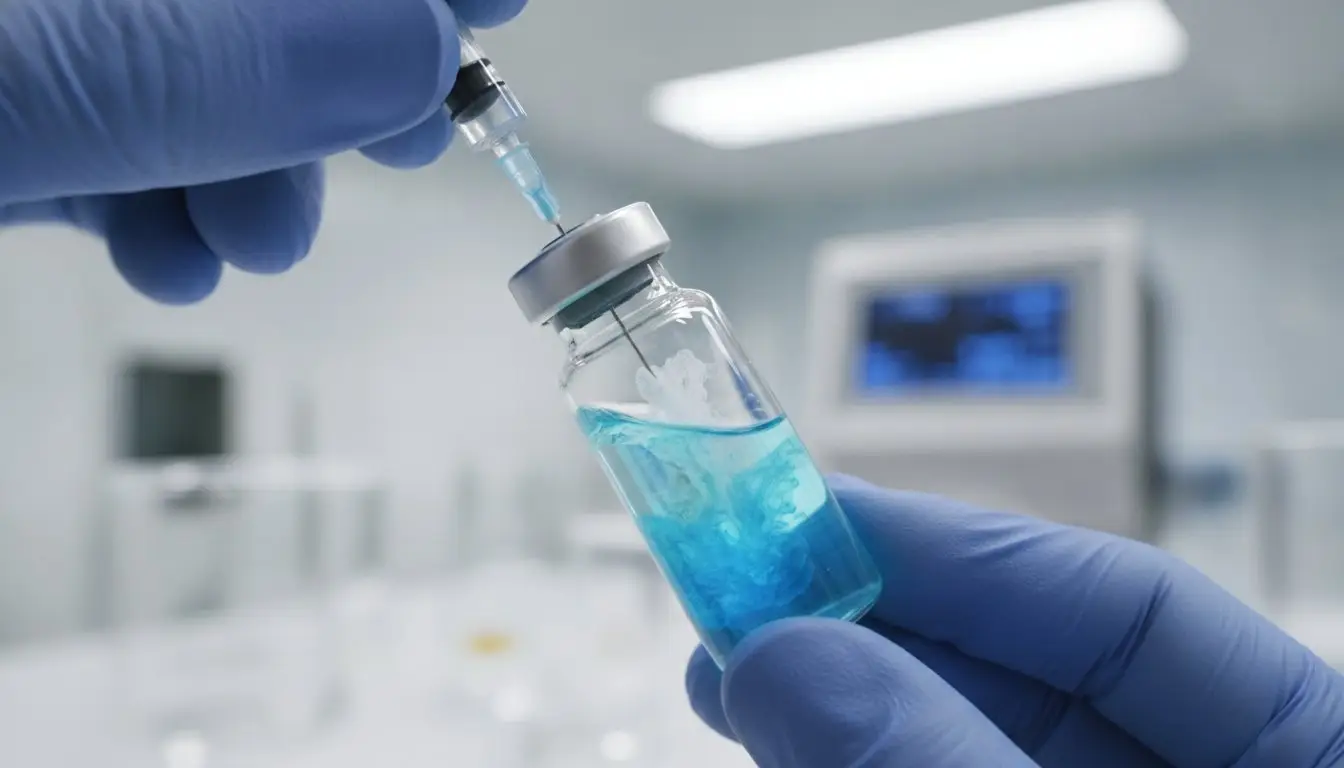
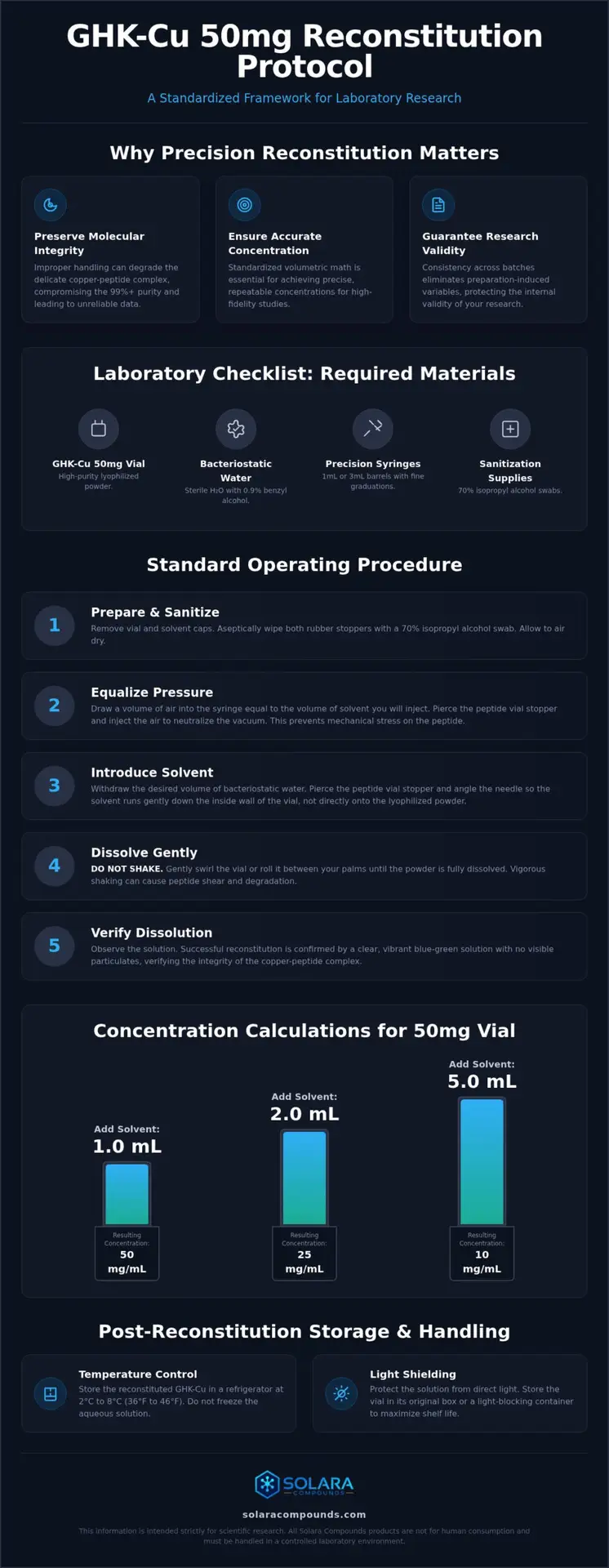
Start by sanitizing the vial tops with a single-swipe motion using a 70% isopropyl alcohol pad. This technique prevents cross-contamination and ensures a sterile entry point for the needle. Draw exactly 2mL of bacteriostatic water into your precision syringe. This volume results in a concentration of 25mg/mL for a standard 50mg vial. Professional-grade vials are typically vacuum-sealed to prevent oxidation. When you puncture the septum, the internal vacuum will attempt to pull the plunger down rapidly. Maintain a firm grip on the syringe to resist this pull. Position the needle at a 45-degree angle against the inner glass wall to ensure the solvent runs down the side rather than splashing directly onto the lyophilized powder.
Follow the steps outlined in how to reconstitute GHK-Cu for precise laboratory results.
The Dissolution Phase
Shaking the vial is strictly prohibited in peptide science. High-velocity movement can lead to peptide shear or the formation of persistent air bubbles that interfere with accurate drawing. Instead, use a gentle swirling technique. Hold the vial by the neck and move it in a slow, circular motion until the powder is fully incorporated into the solvent. During this phase, you’ll observe a distinct chromatic shift. The solution will transform from clear to a characteristic blue-green hue. This transition is a visual indicator of copper ion saturation and complex formation. You can verify these physical properties against established GHK-Cu chemical data to confirm the identity of your sample. Once the solution is completely clear of visible particulates, the reconstitution is complete and ready for controlled laboratory use.
Knowing how to reconstitute GHK-Cu well will lead to successful experiments.
Concentration Math: Dilution Ratios for 50mg Vials
Understanding how to reconstitute GHK-Cu will enhance your research efficiency.
Precision in the laboratory is defined by the accuracy of your dilution ratios. When determining how to reconstitute GHK-Cu, the 50mg vial serves as the standard baseline for high-fidelity research applications. Calculating the final concentration is a straightforward division of the total mass by the volume of the solvent. However, the choice of solvent volume dictates the potency and the physical behavior of the aqueous medium. Researchers must distinguish between volumetric milliliters (mL) and the units often marked on precision syringes. For GHK-Cu, calculations should always prioritize milligrams per milliliter (mg/mL) to ensure research accuracy and data consistency across multi-phase studies.
Common Dilution Ratios for GHK-Cu
The volume of bacteriostatic water you add to a 50mg vial determines the final concentration of the peptide. Different experimental designs require varying potencies. For example, high concentration GHK-Cu research often utilizes a 2mL solvent addition to create a 25mg/mL potency. This is particularly useful for studies where minimal liquid volume is required. Conversely, a 5mL addition results in a 10mg/mL standard research solution. This lower concentration is frequently preferred for broader laboratory observations or when micro-dosing in in vitro plate studies is necessary. Accuracy in these initial steps prevents the need for complex mathematical adjustments during the later stages of your experiment.
- 25mg/mL Concentration: Add 2mL of solvent to a 50mg vial.
- 10mg/mL Concentration: Add 5mL of solvent to a 50mg vial.
- 5mg/mL Concentration: Add 10mL of solvent to a 50mg vial.
Syringe Math and Precision
Mapping the syringe tick marks to the actual peptide mass is the final step in ensuring laboratory precision. On a standard 1mL syringe, there are typically 100 units. It’s vital to remember that these units measure volume, not mass. In a 25mg/mL solution, every 10 units (0.1mL) on the syringe contains exactly 2.5mg of GHK-Cu. You must also account for dead space errors, which can occur in the hub of the needle. Using low-dead-space syringes can mitigate this risk, ensuring that the mass of the peptide you withdraw matches your calculation exactly. Always verify the final volume post-reconstitution; the lyophilized powder itself adds a negligible amount of volume to the solution, but a visual check ensures no leaks or evaporation occurred during the process. Secure the precision your protocol requires by sourcing high-purity GHK-Cu 50mg from Solara Compounds.
Ensure your calculations align with how to reconstitute GHK-Cu precisely.
By mastering these calculations, you eliminate the mathematical variables that can compromise your data. This structured approach to how to reconstitute GHK-Cu provides a reliable framework for any institutional study, regardless of the required concentration levels. This protocol is strictly for scientific research; these compounds are not for human consumption.
By mastering how to reconstitute GHK-Cu, you can secure reliable research outcomes.
Post-Reconstitution Handling: Maintaining Molecular Integrity
Post-reconstitution, remember how to reconstitute GHK-Cu impacts preservation techniques.
After mastering how to reconstitute GHK-Cu, the focus must shift to preservation. The resulting blue-green aqueous solution is significantly more delicate than its lyophilized counterpart. Molecular stability in a liquid medium is governed by thermal energy and light exposure, both of which can catalyze the dissociation of the copper (II) ion from the tripeptide chain. Maintaining a strict temperature range of 2°C to 8°C (36°F to 46°F) is the laboratory standard for preventing accelerated degradation. Deviations from this range can compromise the structural integrity of the complex, leading to inconsistent experimental outcomes. This protocol is designed strictly for scientific research; these compounds are not for human consumption.
Light sensitivity is a critical, yet often overlooked, factor in peptide longevity. GHK-Cu is particularly susceptible to UV-induced photo-degradation. Storing reconstituted vials in amber glass or within a completely dark environment protects the ionic bonds from breaking down prematurely. You should also monitor the solution for physical signs of degradation. Cloudiness, visible precipitation, or a noticeable loss of the characteristic blue hue indicates that the peptide has likely lost its molecular integrity and should no longer be used for high-precision studies.
Learn how to reconstitute GHK-Cu effectively to avoid degradation.
Storage Best Practices for Research Labs
The “freeze-thaw” cycle is a common source of peptide failure. While lyophilized powder remains stable at -20°C for extended periods, you should never freeze the solution once it has been reconstituted. The formation of ice crystals can physically shear the peptide bonds, rendering the sample useless for sensitive assays. We recommend determining an optimal duration for your study-ready solutions, which is typically less than 30 days when stored under ideal conditions. Rigorous labeling is also essential for institutional consistency. Every vial must be clearly marked with the date of reconstitution, the exact concentration (mg/mL), and the batch ID to ensure full traceability during data analysis.
Conclusion: Quality Starts with the Raw Material
Successful research is a direct reflection of the integrity of your starting materials. While knowing how to reconstitute GHK-Cu is vital, the protocol only works if the raw peptide meets the highest standards of purity. Starting with HPLC-verified peptides from Solara Compounds ensures that your baseline is free from synthesis byproducts that might interfere with solubility or complexation. Our 99%+ purity standards provide the stability required for repeatable, high-fidelity results. This protocol serves as a final reminder that all materials are strictly for laboratory and scientific research. For upcoming institutional projects, you can secure your supply of research-grade GHK-Cu 50mg through our verified procurement channels, ensuring your laboratory maintains the precision your work demands.
Successful research relies on knowing how to reconstitute GHK-Cu properly.
Advancing Research Through Precision Preparation
Mastering how to reconstitute GHK-Cu is the essential bridge between raw material science and actionable laboratory data. By adhering to standardized volumetric calculations and maintaining strict environmental controls, you ensure that every assay reflects the true potential of the copper peptide complex. Consistency in these preliminary steps eliminates the preparation variables that often lead to research ambiguity; this allows your data to stand on its own merits and ensures repeatability across institutional studies.
Mastering how to reconstitute GHK-Cu elevates your laboratory work.
Reliable results depend entirely on the integrity of your starting compound. Solara Compounds provides the high-purity GHK-Cu 50mg required for these exacting standards. Every order includes a batch-specific COA and is third-party HPLC and MS verified to ensure 99%+ purity. With secure domestic US shipping, your laboratory can maintain a steady pipeline of verified materials for long-term study success. Note that these products are strictly for scientific research and are not for human consumption.
Procure High-Purity GHK-Cu 50mg for Your Next Research Project and proceed with the confidence that your protocols are built on a foundation of chemical excellence.
Frequently Asked Questions
How much bacteriostatic water do I add to 50mg GHK-Cu?
For a 50mg vial, the volume depends on your required concentration. Adding 2mL of bacteriostatic water creates a 25mg/mL solution, while 5mL results in a 10mg/mL standard. When calculating how to reconstitute GHK-Cu, always prioritize milligrams per milliliter (mg/mL) over generic units to ensure laboratory accuracy. These concentrations allow for precise micro-volume measurements during in vitro or animal-based research protocols.
Understanding how to reconstitute GHK-Cu is critical for determining solutions.
Why did my GHK-Cu turn blue after adding the water?
The blue-green chromatic shift is a standard physical property of the GHK-Cu complex. This color change occurs when the copper (II) ions successfully bind with the glycyl-L-histidyl-L-lysine tripeptide in an aqueous medium. It serves as a visual verification that the copper-peptide complex has formed correctly. If the solution remains clear or turns a different color, it may indicate a purity issue or a dissociation of the copper ions.
To verify your results, consider how to reconstitute GHK-Cu when analyzing data.
Can I use sterile water instead of bacteriostatic water for GHK-Cu?
Sterile water is suitable for immediate, single-use applications, but it lacks the preservative agents needed for multi-day studies. Bacteriostatic water contains 0.9% benzyl alcohol, which inhibits bacterial growth after the initial puncture of the vial septum. For most laboratory protocols, bacteriostatic water is the preferred diluent to maintain a sterile environment throughout the observation period. Note that these materials are strictly for research use and not for human consumption.
For multi-day studies, knowing how to reconstitute GHK-Cu is essential.
How long does GHK-Cu remain stable after reconstitution?
Reconstituted GHK-Cu typically remains stable for up to 30 days when stored under optimal conditions. To maintain molecular integrity, the solution must be refrigerated at 2°C to 8°C (36°F to 46°F) and shielded from light. Beyond this window, the risk of peptide degradation increases, which can compromise the validity of your research data. For projects requiring longer timelines, keep the GHK-Cu in its lyophilized state at -20°C until needed.
Monitor conditions after learning how to reconstitute GHK-Cu for best results.
What happens if I shake the GHK-Cu vial during mixing?
Shaking the vial introduces mechanical stress that can lead to peptide shear or the formation of persistent air bubbles. These bubbles interfere with accurate volumetric drawing and can cause the peptide to denature at the air-liquid interface. Instead of shaking, use a slow, circular swirling motion to assist dissolution. This gentle technique preserves the structural stability of the high-purity complex while ensuring a completely homogenous aqueous research medium.
When mixing, remember how to reconstitute GHK-Cu to avoid damaging the peptide.
Is the vacuum in the GHK-Cu vial normal?
Yes, a vacuum is a standard feature of professional-grade research vials. It is created during the lyophilization process to remove oxygen and moisture, which helps prevent oxidation and extends the shelf life of the powder. When you first puncture the septum, the vacuum will pull the plunger down. You must maintain firm control over the syringe to ensure the solvent is introduced slowly down the side of the glass wall.
Maintaining vacuum integrity is crucial after you know how to reconstitute GHK-Cu.
How should I store GHK-Cu if my research project lasts several months?
For long-term projects, store the lyophilized powder in a freezer at -20°C to maintain maximum stability. Only reconstitute the specific amount of GHK-Cu required for the immediate 30-day phase of your study. Once you learn how to reconstitute GHK-Cu for your specific project, keep the resulting solution in the refrigerator. Avoid freezing the reconstituted liquid, as ice crystal formation can physically damage the delicate peptide bonds and degrade the sample.
Store your solutions properly after mastering how to reconstitute GHK-Cu.
What are the signs that my GHK-Cu solution has degraded?
Visible changes in the solution are the most common indicators of degradation. If the blue-green liquid becomes cloudy, develops sediment (precipitation), or loses its characteristic hue, the molecular complex has likely broken down. These changes often result from improper storage temperatures or contamination. Using degraded samples will lead to unreliable data. Always start with 99%+ purity materials and follow strict aseptic protocols to prevent premature degradation of your research medium.
Ultimately, mastering how to reconstitute GHK-Cu contributes to the quality of your research.
Identifying degradation signs is important when knowing how to reconstitute GHK-Cu.