Research Articles
US Research Peptide Customs Clearance: Lab Buyer’s Guide


Importing laboratory compounds from overseas was once a matter of simple logistics, but the suspension of the $800 de minimis threshold has turned international procurement into a high-stakes regulatory gamble. As of the CBP ruling on June 24, 2026, every commercial shipment entering the United States is subject to formal entry procedures regardless of its value. This shift has fundamentally changed the research peptide shipping regulations USA, making it harder for labs to predict delivery times. You shouldn’t have to worry if your essential materials will actually arrive or if they’ll be intercepted by U.S. Customs and Border Protection. It’s frustrating to wait weeks for a shipment only to receive a seizure notice instead of the high-purity peptides your project requires.
This guide explains how domestic sourcing through Solara Compounds eliminates these logistical hurdles. You’ll learn how to navigate the evolving customs landscape while ensuring your lab receives verified, batch-tested compounds like BPC-157 and SOL-3RT without the risk of border interference. All products available at solaracompounds.com are for laboratory research only and are not for human or animal consumption. We’ll examine the specific documentation requirements and why domestic shipping is the most reliable path to securing high-purity materials for your benchwork.
Key Takeaways
- Learn why the suspension of the de minimis threshold means every international shipment now faces formal entry procedures and increased inspection risks.
- Understand the current research peptide shipping regulations USA and how proper documentation prevents the seizure of essential laboratory compounds.
- Identify how extended border delays can degrade sensitive amino acid chains, compromising the purity required for precise laboratory work.
- Discover how domestic sourcing from Solara Compounds at solaracompounds.com eliminates customs risks while providing verified batch-level documentation for every order.
- Maintain project continuity with fast, Florida-based shipping for high-purity compounds intended strictly for laboratory research only.
The Reality of International Peptide Shipments and US Customs
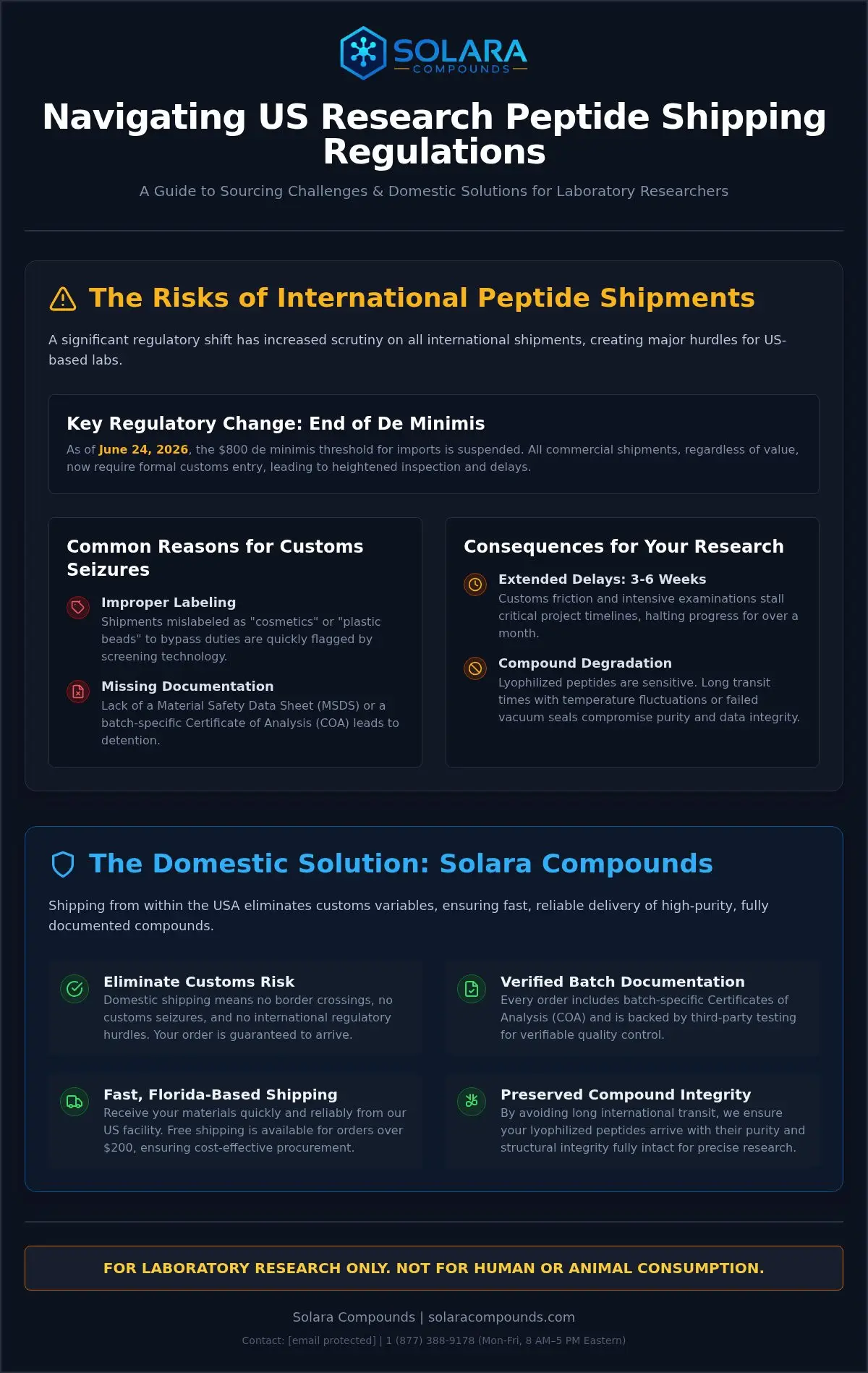
U.S. Customs and Border Protection (CBP) acts as the primary gatekeeper for all materials entering the United States, enforcing trade laws and monitoring chemical imports for regulatory compliance. For lab buyers, this means every package represents a potential point of failure in the supply chain. The research peptide shipping regulations USA have tightened significantly following the June 24, 2026, ruling that suspended the $800 de minimis threshold. This policy shift requires formal entry procedures for all commercial shipments regardless of value, leading to increased scrutiny of small-parcel deliveries. Between December 2025 and March 2026, CBP officers in Cincinnati intercepted over 300 master cartons containing thousands of unmanifested peptide units, illustrating the high level of current enforcement.
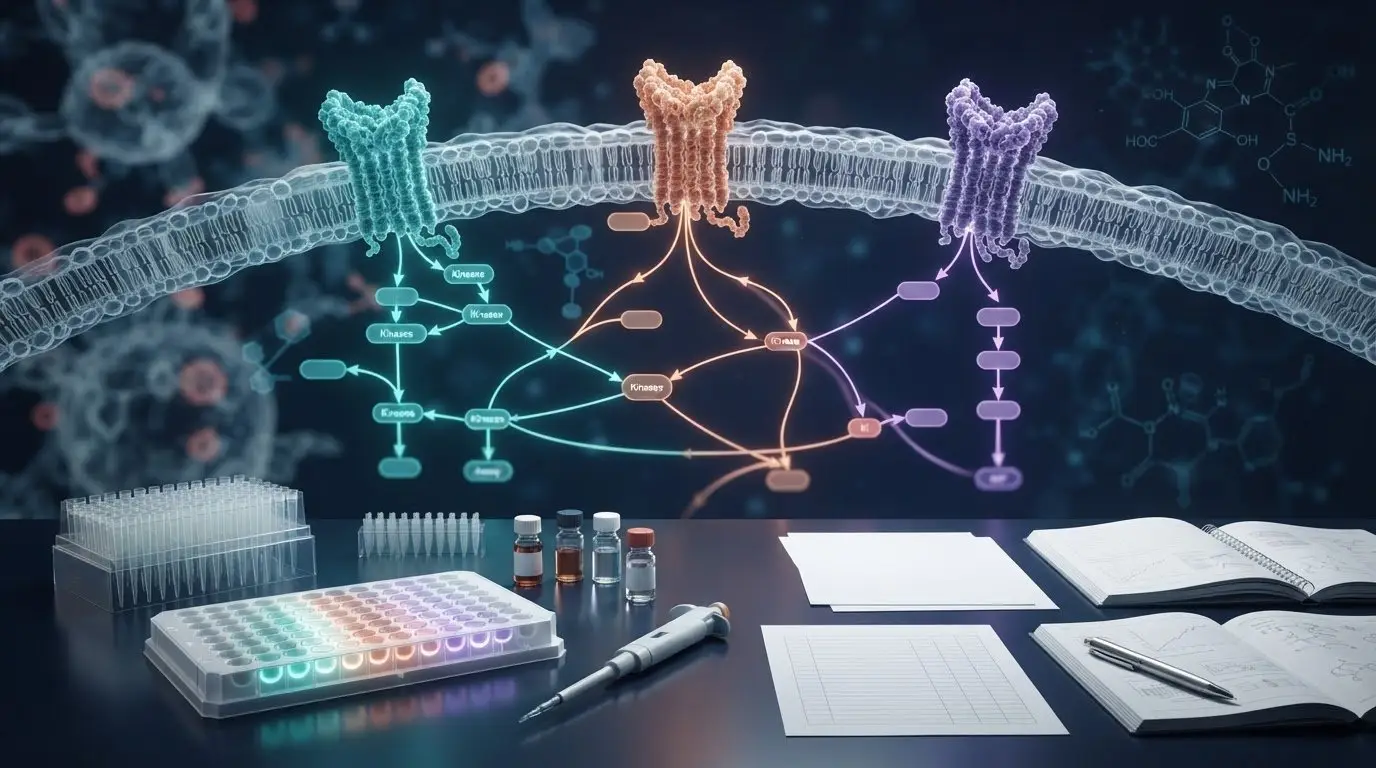
Before analyzing these regulations, it is helpful to establish a scientific baseline. What are peptides? In a laboratory context, they are short chains of amino acids, which are the building blocks of proteins, linked by chemical bonds. Researchers utilize these compounds to study cellular pathways, the series of actions among molecules that lead to specific changes in a cell. Because these materials can influence biological functions, they fall under the dual oversight of the FDA and CBP, often resulting in packages being flagged for intensive examination.
Why Research Compounds Face Scrutiny
International vendors often attempt to bypass duties or inspections by mislabeling shipments as “cosmetics” or “plastic beads.” CBP identifies these discrepancies quickly using advanced screening technology. When a package lacks a proper Material Safety Data Sheet (MSDS) or a batch-specific Certificate of Analysis (COA), it is frequently detained. The intersection of FDA oversight and CBP enforcement means that any compound not conforming to manufacturing standards or lacking clear intent can be seized. This regulatory friction often results in 3-6 week lead times and high seizure rates that stall critical laboratory work.
The Logistical Burden of Global Sourcing
Shipping peptides across oceans introduces physical risks that can compromise your data integrity. Lyophilized peptides, which are freeze-dried for stability, remain sensitive to temperature fluctuations during long transit times. Heat exposure can lead to degradation, meaning the compound you receive may not match the purity levels reported at the point of origin. Additionally, invasive customs inspections often involve puncturing outer packaging, which can lead to vacuum-seal failure and expose the compound to moisture. The Research Use Only (RUO) designation serves as the critical legal framework for laboratory-grade chemical procurement, ensuring compounds are utilized strictly for scientific inquiry.
Domestic sourcing through Solara Compounds at solaracompounds.com removes the customs variable from the equation. By shipping exclusively within the United States from our Florida facility, we help lab buyers avoid the risks of international transit and border seizures. All products are for laboratory research only and are not for human or animal consumption. Choosing a domestic partner ensures that your research materials arrive with their structural integrity intact and their documentation verified.
Compliance with the Federal Food, Drug, and Cosmetic Act (FD&C Act) is the foundation of all chemical imports into the United States. While many researchers assume that the possession of non-scheduled compounds is inherently protected, the act of importing them introduces a separate layer of federal oversight. The FDA regulates peptides as drugs, meaning that any compound not specifically approved for human use is classified as an “unapproved new drug” if it is intended to affect the structure or function of a body. To stay within the legal boundaries of research peptide shipping regulations USA, lab buyers must ensure that every shipment is classified correctly using the Harmonized Tariff Schedule (HTS). Most research peptides fall under specific HTS codes like 2937 or 3822, which identify them as hormones or laboratory reagents. Misclassifying these materials as general merchandise is a primary reason for immediate seizure.
The RUO Designation and Compliance
The “Research Use Only” (RUO) label is not a mere suggestion; it is a mandatory regulatory claim. According to FDA guidelines for ‘Research Use Only’ products, this designation must be prominently displayed on all packaging and documentation to clarify that the materials are not for clinical use. Furthermore, chemical imports are subject to the Toxic Substances Control Act (TSCA), which requires importers to certify that the substances are either on the TSCA inventory or are being used strictly for research and development. Institutional buyers, such as university labs, often require rigorous documentation to satisfy internal compliance boards, whereas independent researchers may overlook these steps, leading to increased risk at the border. Ensuring your lab is stocked with high-purity compounds like BPC-157 or TB-500 requires a partner that understands these documentation standards. You can review the current research catalog at Solara Compounds to see how we handle these requirements domestically.
CBP Seizure Notices and Your Rights
When a package is detained, U.S. Customs and Border Protection (CBP) issues a Notice of Seizure or an Information Request. This document typically arrives via mail and provides the importer with a specific timeline, often 30 days, to respond or petition for the release of the goods. For laboratory buyers, this process is rarely successful without a continuous bond and extensive legal support. The financial impact of these seizures extends beyond the lost cost of the materials; it results in significant delays to project timelines and the loss of critical data. All products from Solara Compounds are for laboratory research only and are not for human or animal consumption. By sourcing from solaracompounds.com, researchers bypass these international hurdles, as our Florida-based operations ensure that your materials never have to face a CBP inspection desk.
Common Reasons for Research Peptide Customs Seizures
International procurement carries a high risk of administrative failure. While researchers focus on experimental design, the physical arrival of compounds is often halted by simple documentation errors. The research peptide shipping regulations USA empower CBP to intercept any shipment that appears non-compliant or intentionally deceptive. One frequent trigger is a discrepancy between the declared value on the commercial invoice and the actual market price. When a vendor undervalues a shipment of SOL-3RT or SOL-2TZ to reduce duty costs, it creates a red flag for mis-manifesting. This typically leads to an immediate hold and a formal request for proof of payment.
Documentation Failures
A generic invoice stating “chemical reagents” is no longer sufficient for high-purity materials. Customs agents require specific identifiers, such as CAS numbers and precise chemical names, to verify the nature of the cargo. If the documentation doesn’t match the labels on the physical vials, the package is flagged. High-purity research materials require batch-specific High-Performance Liquid Chromatography (HPLC) and Mass Spectrometry (MS) data for verification. HPLC is a technique used to separate and quantify the components of a mixture; meanwhile, MS identifies the chemical structure of those components. Without this lot-specific paperwork, CBP cannot verify the contents, often leading to the destruction of the package. Missing lot numbers on multi-vial kits further complicate this clearance process.
Regulatory Red Flags
Customs agents use automated systems to scan for keywords associated with unapproved medical claims. Terms like “therapeutic,” “healing,” or “clinical trial” trigger secondary inspections. The FDA maintains strict oversight through policies like the Detention of Unapproved New Drugs, which allows for the hold of shipments without a physical exam. Sourcing from international jurisdictions known for chemical diversion also increases the likelihood of a seizure. Bulk institutional orders are scrutinized more heavily because the volume suggests a higher potential for non-research application. Stealth shipping methods, such as hiding vials inside unrelated consumer goods, almost always result in a permanent seizure and possible legal inquiry.
Solara Compounds eliminates these risks by shipping directly from our Florida facility. When you source BPC-157 or TB-500 from solaracompounds.com, you bypass the volatility of international borders entirely. Every shipment includes batch-level COAs to ensure you receive the high-purity compounds your lab requires. All products are for laboratory research only and are not for human or animal consumption. By choosing a domestic partner, you ensure your research remains on schedule without the threat of a seizure notice.
The Hidden Quality Risks of Gray-Market International Sourcing
International procurement often creates a false sense of economy. While the unit price from an overseas wholesaler may appear lower, the hidden costs of degraded materials and failed data points quickly erode those savings. The current research peptide shipping regulations USA mean that packages often sit in non-climate-controlled warehouses for weeks during the clearance process. These delays expose sensitive amino acid chains to environmental stressors that can compromise the structural integrity of the compound before it ever reaches your bench. Relying on gray-market vendors means accepting a level of instability that can jeopardize months of laboratory work.
Degradation and Environmental Stress
Lyophilized powders are highly susceptible to moisture and heat. During the 30-day holds common with CBP inspections, temperature fluctuations can trigger premature degradation of the peptide bonds, altering the chemical properties of the substance. There’s also the concern of high-energy X-ray scanners used at border crossings. While these are necessary for security, their impact on the molecular integrity of complex research chemicals is a variable most labs prefer to avoid. HPLC analysis provides a precise quantification of the compound’s purity, making it the only way to confirm a peptide survived the import process without degradation.
The Paperwork Purity Problem
Traceability is the backbone of reliable science. Many international gray-market vendors utilize recycled Certificates of Analysis (COAs), which are single test results applied to multiple subsequent batches over several months. This practice makes it impossible to verify the specific purity of the vials in your hand. Sourcing compounds like BPC-157 or TB-500 without domestic lot-tracking introduces a significant risk of receiving sub-98% purity batches. Solara Compounds addresses this by providing third-party testing through Kovera Labs for every lot we distribute. You can Check the batch COA to see our domestic verification standards firsthand.
Navigating research peptide shipping regulations USA is a complex task that often compromises the quality of your materials. We focus on HPLC purity targeting >98% and ship exclusively within the US to ensure your materials arrive in peak condition. All products from Solara Compounds are for laboratory research only and are not for human or animal consumption. To secure verified materials for your next project, Shop research peptides at solaracompounds.com.
Eliminating Import Risk with Domestic Sourcing and Batch Verification
The most effective way to navigate the complexities of research peptide shipping regulations USA is to bypass international borders entirely. By choosing a domestic supplier, you remove the unpredictable variable of customs clearance from your laboratory’s timeline. Solara Compounds operates from a Florida-based facility, ensuring that every vial in our catalog is already within the United States and ready for dispatch. This domestic approach eliminates the risk of federal seizure and protects the chemical integrity of your compounds by avoiding long-duration international transit.
Domestic Supply Chain Integrity
Project start-dates shouldn’t be dictated by a CBP inspection queue. Sourcing from a domestic partner like Solara Compounds provides a level of security that international gray-market vendors cannot replicate. We prioritize speed and safety, offering reliable transit times that allow your research to proceed without interruption. Our domestic supply chain offers several key advantages for laboratory buyers:
- Reduced Transit Stress: Domestic shipping minimizes the time sensitive compounds spend in non-climate-controlled environments, preserving the integrity of amino acid chains.
- Zero Customs Risk: Because our inventory is already stateside, packages never face the threat of seizure or invasive border inspections.
- Cost Optimization: We provide free shipping on orders over $200 within the United States, helping labs manage their procurement budgets more effectively.
You can Shop research peptides for immediate domestic dispatch and avoid the typical 3-6 week lead times associated with overseas freight. This efficiency ensures your lab stays on schedule while maintaining a secure chain of custody.
Verifying Your Research Materials
Purity isn’t an assumption; it’s a documented fact. Our Documentation-First approach ensures that batch-level COAs are available before you receive your materials. We utilize a sophisticated lot-tracking system that allows researchers to access HPLC and MS reports instantly, providing the empirical data required for precise scientific inquiry. Every compound in our catalog is synthesized in an ISO 7 cleanroom and undergoes sterile lyophilization to maintain maximum structural stability. Researchers focusing on metabolic pathways can select SOL-3RT or SOL-2TZ for high-purity metabolic research.
All products from Solara Compounds are for laboratory research only and are not for human or animal consumption. By sourcing from solaracompounds.com, you ensure that your laboratory receives high-purity materials without the administrative burden of international customs. Our commitment to batch-level verification and domestic logistics makes us a stable partner for your long-term research success.
Securing Your Laboratory Supply Chain
Navigating the research peptide shipping regulations USA doesn’t have to be a barrier to your scientific progress. While international procurement often leads to seizures or degraded materials, choosing a domestic partner ensures your project stays on schedule with high-purity compounds. You’ve learned that documentation like batch-specific COAs and transparent HTS classification are essential for compliance; however, these are often the first things to fail in overseas shipments. By sourcing within the United States, you eliminate the risk of border holds and environmental stress on your sensitive lyophilized powders.
Solara Compounds provides a reliable alternative through our Florida-based facility. Every order includes batch-specific COAs verified by Kovera Labs, ensuring the structural integrity of your materials. We offer free shipping on orders over $200 within the United States, removing the unpredictability of international freight. You’re ready to focus on your benchwork instead of logistics. View the current research catalog at Solara Compounds to secure the high-purity materials your lab requires.
Frequently Asked Questions
Do I need a special license to buy research peptides in the USA?
No specific license is required for purchasing research peptides, provided the buyer is a qualified researcher and the compounds are for laboratory use only. These materials fall under the Research Use Only (RUO) framework, which exempts them from certain clinical drug regulations. However, institutional buyers in cities like Boston or San Diego often have internal compliance protocols. It’s essential to understand that the buyer assumes full responsibility for adhering to all research peptide shipping regulations USA.
What happens if my international peptide shipment is seized by customs?
If a shipment is detained by U.S. Customs and Border Protection, you’ll typically receive a formal Notice of Seizure or an Information Request via mail. This document outlines the reason for detention, such as mis-manifesting or lack of FDA approval for the compound. You generally have 30 days to respond or petition for release. For most laboratory buyers, this process results in the permanent loss of both the materials and the procurement funds.
Can I track my research peptide shipment through CBP processing?
Tracking a shipment through CBP processing is often impossible for the end-user, as packages enter a black hole during secondary inspections. While a carrier may show a “processed through facility” status, the granular details of the formal entry aren’t shared with the recipient. This lack of visibility is a primary reason why researchers in hubs like San Francisco or Seattle prefer domestic sourcing. Domestic tracking provides end-to-end transparency that international freight simply cannot offer.
Why is domestic sourcing preferred for BPC-157 and TB-500?
Domestic sourcing is preferred for BPC-157 and TB-500 because it eliminates the high risk of customs seizures associated with these popular research tools. International shipments of these compounds are frequently flagged under FDA import alerts. By purchasing from Solara Compounds, you ensure that your materials never face border delays. This protects the lyophilized powder from environmental stress and ensures your research peptide shipping regulations USA compliance remains intact throughout the entire procurement cycle.
Does Solara Compounds ship internationally to bypass local customs?
Solara Compounds doesn’t ship internationally and focuses exclusively on serving the United States market from our Florida facility. We don’t attempt to bypass local customs in other countries; instead, we specialize in providing a secure domestic supply chain for U.S.-based researchers. This commitment allows us to maintain fast shipping times to cities like Miami, Houston, and Austin. Our products are for laboratory research only and are not for human or animal consumption.
How do I verify the purity of a domestically sourced research peptide?
You should verify purity by reviewing the batch-specific Certificate of Analysis (COA) provided by the supplier. At Solara Compounds, we utilize third-party testing through Kovera Labs to ensure every lot meets our minimum 98% purity threshold. Researchers can use our unique lot-tracking system at solaracompounds.com/coa/ to access HPLC and MS reports. This data confirms the chemical identity and concentration of the compound, ensuring your experimental results are based on high-purity materials.
What documentation should I expect with my laboratory research order?
A professional laboratory research order should include a batch-specific COA, a Material Safety Data Sheet (MSDS), and a commercial invoice with accurate HTS codes. These documents provide the necessary technical data and safety information for your lab’s records. Solara Compounds prioritizes this documentation-first approach, assigning a unique lot number to every batch for full traceability. This level of detail is critical for researchers in biotechnology hubs like Raleigh or Philadelphia who require rigorous data integrity.
Is there a risk of degradation during domestic shipping within the US?
While all chemical compounds are subject to degradation, the risk is significantly lower during domestic transit compared to international freight. Solara Compounds utilizes sterile lyophilization and vacuum sealing to stabilize our peptides, such as SOL-3RT and SOL-2TZ, for transport. Fast domestic shipping from Florida to locations like Denver or Phoenix minimizes heat exposure. Our lyophilized powders are engineered for stability, but we recommend proper laboratory storage upon arrival to maintain the structural integrity of the amino acid chains.