Research Articles
Research Compound Quality Assurance: A Practical Framework for Laboratory Buyers


What if a high purity percentage tells you less than the batch record behind it? For lab buyers, research compound quality assurance depends on a connected chain of evidence, not one number on a Certificate of Analysis (COA). A COA may be hard to match to the lot being purchased, and a testing label means little unless it shows what was measured.
Those concerns are reasonable. Reliable procurement requires clear answers about identity, purity, testing methods, and lot traceability. This guide offers a repeatable framework for reviewing those details, comparing supplier claims, and identifying what the documentation does and doesn’t verify.
We’ll look at how to match a COA to a batch, interpret purity results alongside identity testing, and understand the role of independent third-party analysis. Solara Compounds provides batch-specific COAs and unique lot numbers, with stated molecular confirmation by MALDI-TOF and LC-MS and independent testing through Kovera Labs. These records support informed purchasing, but they don’t guarantee experimental outcomes. Learn more at solaracompounds.com. All products are solely for laboratory research and are not for human or animal use.
Key Takeaways
- Research compound quality assurance is an evidence chain: distinguish documented supplier processes from individual quality control results.
- Read purity and identity results as separate evidence, since each addresses a different question about the material.
- Use a repeatable procurement review to check material details, batch records, and supporting documentation before purchase.
- Keep supplier process statements, analytical reports, and purchasing records distinct so each claim can be assessed on its own.
- Research compounds are for laboratory research only, not for human or animal use.
What Research Compound Quality Assurance Means for Laboratory Buyers
Research compound quality assurance is the documented system of controls and evidence used to evaluate a material’s identity, purity, and batch traceability; it supports purchasing review but does not establish whether the material is suitable for a particular experiment or predict its results.
This definition separates the evidence from the conclusion a researcher might be tempted to draw from it. A supplier’s quality system describes how processes are managed. Individual quality control tests provide findings about a sample or batch. Both are useful, but neither alone proves that a compound will perform as expected in a laboratory application.
The distinction reflects broader Quality Assurance Principles, which treat quality assurance as a system of planned activities and quality control as checks on specific outputs. For buyers, that means reviewing both the process behind the material and the records that document the batch under consideration.
How quality assurance differs from a single test result
A test result answers a limited question. A process record describes controls or procedures used during production, while an analytical result reports what a particular method found in the tested material. A certificate may bring information together, but the document’s presence alone doesn’t show that every relevant question has been answered.
- Identity: Does the analytical evidence support that the material is the compound named?
- Purity: What does the reported method indicate about the measured sample, and what does that method not assess?
- Traceability: Can the material be connected to a specific lot and its records?
These categories are related, not interchangeable. A purity result is not, by itself, identity confirmation. A supplier’s description of its processes does not replace analytical evidence, and neither establishes experimental suitability. Researchers should treat documentation as a basis for informed evaluation, not a guarantee of experimental outcomes.
Why batch-level evidence matters in research purchasing
A lot number provides the link between the item received and the records associated with its production and testing. Before completing a purchase review, compare the lot number on the material or its packaging with the number on the corresponding batch documentation. If the records refer only to a general product, they may not establish that the evidence applies to the batch being purchased.
That’s why a broad purity statement or product-page claim cannot stand in for batch-specific evidence. The claim may describe a general standard, while the batch record connects documentation to a defined lot. Keeping the purchase record, lot identifier, and relevant certificate together gives procurement teams a consistent trail to review later and helps laboratories document which material was received.
Solara Compounds provides batch-specific Certificates of Analysis (COAs) through its batch COA resource, with unique lot numbers for traceability. Lab buyers can compare the identifier on a COA with the purchased material before filing the record. Products from Solara Compounds are for laboratory research only and are not for human or animal use.
How Research Compound Quality Assurance Connects Process, Testing, and Traceability
Research compound quality assurance is strongest when its evidence connects three stages: stated production controls, analytical testing, and records tied to the specific batch. Each stage answers a different question. Process descriptions explain how a supplier says material is produced and handled; testing reports provide measured findings; batch records connect those findings to a defined lot.
For a lab buyer, the practical check is whether the chain stays connected. A production claim without analytical evidence describes a process, not a tested result. A test report without a clear batch identifier may be difficult to relate to the material under review. Documentation should make those links clear without implying that a compound will produce a particular experimental outcome.
- Production controls: What manufacturing and handling practices does the supplier state?
- Analytical evidence: What did each test measure, and what question does its result answer?
- Batch documentation: Can the records be connected to the lot associated with the purchased material?
What production and handling controls contribute
Solara Compounds describes solid-phase synthesis in an ISO 7 cleanroom as part of its stated production practices. The company also describes sterile lyophilization and vacuum sealing. These statements provide process context, but buyers should distinguish a description of handling or production from analytical evidence about a particular batch. A process claim alone doesn’t establish identity, measured purity, or experimental suitability.
Production controls matter because they document how a supplier says it manages manufacturing and handling. They don’t answer every material-specific question. The FDA’s FDA Compounding Quality Center of Excellence discusses quality efforts for compounded drugs, a different category from research-only compounds. Its information can provide general context on quality practices, but it should not be read as batch evidence or as a standard that automatically applies to research materials.
How analytical methods contribute to the evidence chain
Analytical methods answer specific questions. HPLC, or high-performance liquid chromatography, separates components in a sample so the relative chromatographic purity can be assessed. It doesn’t, on its own, establish that the compound has the intended molecular identity. A purity result and an identity result are different evidence, even when they appear on the same certificate.
Solara Compounds states that it uses MALDI-TOF and LC-MS for molecular confirmation. In everyday terms, these methods measure molecular mass-related signals and compare them with the expected molecular information. That supports an identity assessment, while the reported method and its results still need to be read on their own terms.
The company also states that independent third-party testing is conducted through Kovera Labs. This adds another source of analytical evidence to supplier documentation; it doesn’t guarantee a research result. Buyers can follow the chain by checking that the report identifies the tested material and that its lot information corresponds with the batch records.
Lot traceability completes the connection. A unique lot identifier links the material, relevant analytical report, and purchasing documentation, helping a laboratory retain a coherent record for procurement review. To see the research materials offered by Solara Compounds, view the research compound catalog. Products are for laboratory research only and are not for human or animal use.
How to Evaluate a Research Compound COA Without Overreading Its Claims
A Certificate of Analysis (COA) is most useful when its details connect the document to the material under review. Treat it as a record of reported results, not as a general guarantee. In research compound quality assurance, careful reading means checking what the certificate identifies, what methods it reports, and which questions those results can reasonably answer.
Which COA details should laboratory buyers match
Start with the compound name or identifier and compare it with the item received and the purchasing record. Then match the COA’s lot number to the material’s lot number. A certificate for the same compound but a different lot doesn’t establish the results for the batch in hand.
Next, locate the analytical method and the result it supports. A COA should be batch-specific, rather than a general product sheet that presents claims without identifying the tested lot. Solara Compounds makes batch COAs available through its COA resource, which lab buyers can use alongside their purchasing and receiving records.
What a COA can and cannot establish
A COA can document reported batch-level findings, such as identity confirmation or a purity result, when those fields and their supporting methods are provided. Read each result within its scope. A listed identity method supports an identity assessment; a reported purity value describes the outcome of a particular purity analysis.
Neither result should be stretched into a claim about every quality attribute. A purity percentage alone doesn’t confirm identity, establish the absence of every possible impurity, or show that a material is suitable for a specific assay. The COA also can’t guarantee an experimental outcome. It contributes evidence for procurement review, while researchers determine what additional information their laboratory requirements call for.
Use the comparison as a reading aid, not a pass-or-fail formula. If a field is absent or unclear, record that as a limit in the procurement review rather than assuming the missing information is covered by another result. Keep the COA with the order record and receiving documentation so the basis for the purchase remains clear.
Products from Solara Compounds are for laboratory research only and are not for human or animal use.
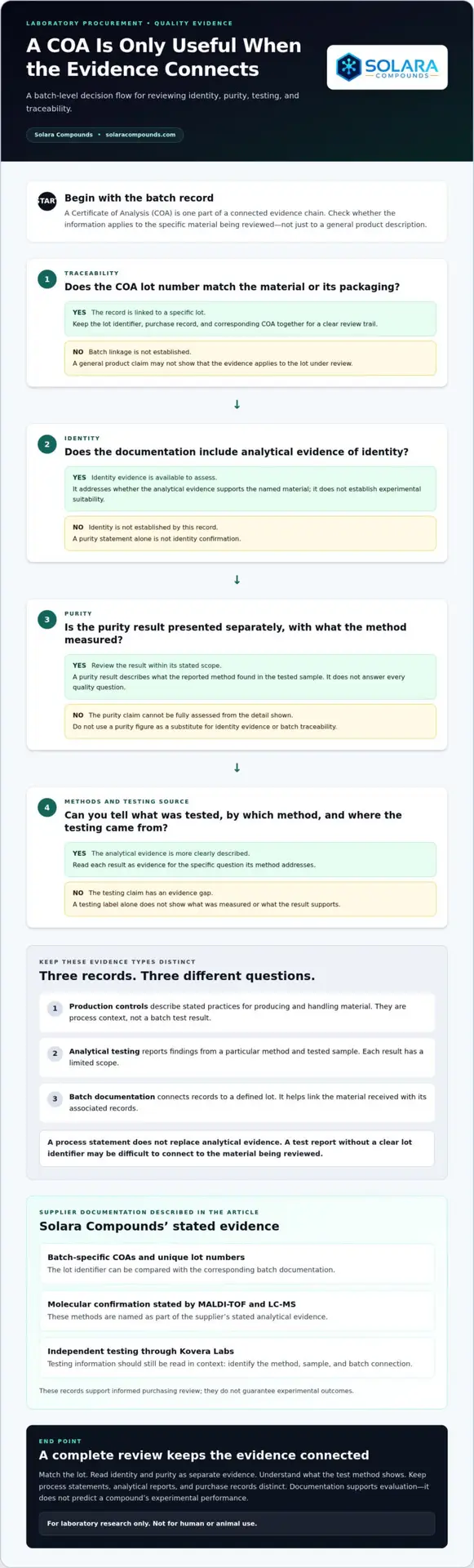
A Practical Research Compound Quality Assurance Review for Procurement
A consistent review process helps lab buyers assess research compound quality assurance before an order and preserve the supporting records afterward. Keep three kinds of information distinct: supplier statements about production, analytical reports describing test findings, and procurement records documenting what was ordered and received. This separation makes gaps easier to identify without guessing at their cause.
A repeatable evidence review before placing an order
Use the following sequence to move from material identification to a documented purchasing decision. Record what each source actually states, rather than treating a general claim as evidence for a specific lot.
- Identify the material. Record its exact compound name and the product description used in the purchasing record. Note the lot identifier when it is available, and check whether the supporting documentation refers to that same material and batch.
- Separate process claims from test evidence. List supplier statements about production or handling in one place. Review analytical reports separately, noting the method, reported result, and the question each finding addresses.
- Compare claims with documents. For each quality statement, identify the record that supports it. A general description of a supplier’s process and a batch-level result are different types of evidence, so don’t use one as a substitute for the other.
- Record unresolved differences. If a lot number, compound identifier, or document detail doesn’t match, note the exact fields and files involved. Mark the discrepancy as unresolved in the review. Don’t assume it is a clerical error, a testing issue, or evidence of a material problem without supporting information.
- Document the purchasing decision. Retain the reviewed records with the order documentation, along with a concise note describing what evidence was available and any open questions relevant to procurement.
This sequence also gives teams a practical way to compare supplier claims with their underlying records. For further background, independent peptide testing and high-purity sourcing are useful related topics, but the evidence for a particular purchase still needs to be assessed against the material and batch under review.
Recordkeeping after laboratory receipt
At receipt, compare the lot identifier on the material with the purchasing entry and batch COA. Record the received identifier in the laboratory’s inventory or procurement system, then retain the COA with the matching order and receiving records. If an identifier or document detail differs, preserve the records as received and log the discrepancy clearly rather than silently changing the entry.
Keep quality documentation separate from experimental interpretation and results. A COA records reported analytical findings; laboratory records document how researchers handled and evaluated material in their work. Maintaining both creates a clearer history without implying that supplier documentation determines experimental suitability or outcome.
Solara Compounds provides batch documentation and lot traceability for its research compounds. Lab buyers can view the research compound catalog and apply the same evidence review to the relevant purchasing records. Products are for laboratory research only and are not for human or animal use.
Solara Compounds’ Documentation-First Approach to Research Compound Quality
For laboratory buyers, a supplier’s quality claims are most useful when the supporting records connect to a defined batch. Solara Compounds describes a documentation-focused approach that includes batch-specific Certificates of Analysis (COAs), unique lot numbers, and independent third-party testing through Kovera Labs. Together, these records and claims give buyers evidence to review. They don’t guarantee experimental suitability or results.
How Solara’s stated documentation supports buyer review
A lot number links a research material to its batch record. Compare the identifier on the material with the corresponding COA, then retain both with the purchase documentation. Solara Compounds makes batch COAs available through its COA resource. This traceable connection helps a buyer review which findings apply to a particular lot rather than relying only on a general product description.
The company states that independent third-party testing is conducted through Kovera Labs. This offers an additional source of analytical evidence alongside supplier documentation, but the testing claim should still be read in context: review the report, its stated methods and results, and the batch identifier. Third-party testing supports evidence review; it isn’t a promise about how a material will perform in a laboratory investigation.
Reading purity claims in context
Solara Compounds states an HPLC purification target of greater than 98% minimum purity. Some product pages may use product-specific wording such as 99%+ or at least 99% HPLC purity. These statements shouldn’t be blended into a broader claim. Read the wording attached to the relevant product and compare it with the batch documentation; an HPLC purity figure doesn’t, by itself, establish molecular identity or every other quality attribute.
For a practical research compound quality assurance review, keep each claim connected to its source. Distinguish supplier statements about process from analytical findings and the records tied to the purchased lot. If a claim and its supporting document appear to differ, note the exact wording and identifiers for review rather than assuming they mean the same thing.
- Product wording: Note the stated purity claim and method as presented for that product.
- Batch record: Match the lot number and review the COA’s reported methods and results.
- Procurement file: Retain the product information, COA, and purchasing record together.
Solara Compounds supplies research peptides and selected research compounds through solaracompounds.com. Buyers can review relevant batch documentation before laboratory work and keep it with their procurement records. For laboratory research only. Products are not medicine or supplements and are not for human or animal use.
Shop research peptides at solaracompounds.com.
Make Evidence Review Part of Every Purchase
Build a consistent documentation review into your procurement routine, including for repeat orders. Keeping a clear record of what was evaluated and what remains uncertain gives researchers a stronger basis for future purchasing decisions and helps maintain organized laboratory records as projects develop.
That discipline is the practical value of research compound quality assurance: it turns quality statements into claims that can be reviewed against evidence, without treating paperwork as a prediction of experimental performance. Apply the same careful standard to each order to support clear, well-documented procurement decisions.
For questions, contact Solara Compounds at [email protected] or 1 (877) 388-9178, Monday-Friday, 8 AM-5 PM Eastern. When you’re ready to consider materials for laboratory work, view the current research catalog. Products are for laboratory research only, not medicine or supplements, and not for human or animal use. Move forward with a clear research purpose and a careful documentation process.
Frequently Asked Questions
Does a batch-specific COA guarantee that a research compound will perform as expected in an assay?
No. A batch-specific COA records reported findings for a defined lot, but it can’t predict assay performance. Results may also depend on the laboratory method, sample handling, and experimental conditions. Treat the certificate as evidence for procurement and material review, then assess whether its reported methods address questions relevant to the planned assay. It isn’t a substitute for experimental validation or a guarantee of results.
What should a laboratory buyer do if the lot number on a COA does not match the received item?
Pause acceptance into the study workflow until the discrepancy is documented and resolved. Don’t assume either number is a typo. Retain the packaging and order details, then record both identifiers and the date received. Request documentation that matches the item or instructions on how to proceed. Keep the mismatch visible in procurement records until corrected, rather than overwriting the original entry.
Does third-party testing replace a supplier’s own quality documentation?
No. Third-party analysis adds an external test report, while supplier records may document lot assignment and process information. Review both sources for the material identifier, lot, method, and reported scope. If the external report covers a different sample or analytical question, it may not answer the same question as the supplier’s COA. Keep each document’s role clear in the procurement file; neither guarantees an assay outcome.
How should laboratories retain batch records for future procurement review?
Keep the COA with the purchase order, receiving record, and inventory entry, using the lot number in the file name or index. Record the supplier, material identifier, receipt date, and any discrepancy note so another buyer can retrieve the same file set. Laboratories in Boston, San Diego, San Francisco, New York, Houston, Miami, Los Angeles, Austin, Raleigh, Seattle, Chicago, Philadelphia, Baltimore, Dallas, Phoenix, Tampa, Atlanta, and Denver can use this consistent approach.
Can a purity result alone establish that a material is suitable for a specific research method?
No. A purity result reports what a particular analysis found, not whether a material meets every need of a specific assay. Researchers should consider whether the available identity information and reported test methods address the questions their method requires. They should also document any relevant evidence gaps during review. Research compounds are for laboratory research only and are not for human or animal use.
What is the difference between quality assurance and quality control for research compounds?
Quality assurance concerns the planned system for managing and documenting quality, while quality control refers to checks and test results for materials or batches. For example, a procurement team might use a defined document-review process as part of assurance, then record a COA’s reported batch findings as quality control evidence. Research compound quality assurance considers how those records work together, without treating a single result as proof of every quality attribute.
Should researchers review a new batch’s COA even when they have purchased the same compound before?
Yes. A repeat purchase may come from a different lot, so the previous batch’s certificate doesn’t document the new material. Review the new COA and compare its identifier, lot information, methods, and reported results with the current order. File it separately from earlier batch records. This helps procurement teams distinguish lot-specific evidence over time and avoids carrying forward an older document by mistake.