Research Articles
Understanding Peptide HPLC Analysis Reports: A Researcher’s Guide to Purity Verification


A Certificate of Analysis is a laboratory’s primary defense against research variability, yet it is often treated as a mere formality. Relying on a summary percentage without scrutinizing the raw peptide HPLC analysis reports exposes your study to significant risks, ranging from batch-to-batch inconsistency to the accidental use of contaminated compounds. You already know that even a minor variance in chemical purity can compromise the reproducibility of your results. It is difficult to distinguish between authentic data and forged documents when the source lacks transparency, leaving your research integrity in a state of uncertainty.
This guide provides a technical framework for evaluating HPLC and MS data to ensure the structural integrity of your research peptides. We’ll examine how to read chromatogram baselines, identify impurity peaks at the 0.10% threshold, and verify molecular weight using orthogonal mass spectrometry methods. You will gain the confidence to source high-purity materials and establish standardized protocols for your internal quality audits. Precision is the foundation of reliable science; it’s time to verify the data that drives your discoveries.
Key Takeaways
- Master the technical fundamentals of High-Performance Liquid Chromatography to differentiate between high-grade research materials and substandard alternatives.
- Learn to interpret the specific metrics of a chromatogram, focusing on how to calculate the Area Under the Curve (AUC) for precise purity verification.
- Discover the necessity of mass spectrometry as an orthogonal method to confirm exact molecular weight and detect hidden isomeric impurities.
- Identify critical red flags in peptide HPLC analysis reports, such as artificially smoothed baselines or the absence of batch-specific identifiers.
- Establish a standardized framework for internal quality control by utilizing transparent, third-party verified data for every research compound.
What is HPLC Analysis in Peptide Research?
High-performance liquid chromatography (HPLC) is a precision separation technique used to isolate and quantify each component within a chemical mixture. In the context of peptide synthesis, it serves as the definitive method for assessing chemical purity. The process involves a mobile phase, usually a liquid solvent, carrying the peptide sample through a stationary phase within a pressurized column. Different molecules interact with the stationary phase at varying intensities, causing them to elute at distinct intervals. This separation allows researchers to see exactly what is in the vial beyond the primary compound. High-quality peptide HPLC analysis reports provide a visual and mathematical representation of this separation, ensuring that the amino acid sequence is free from truncated sequences or deletion mutations.
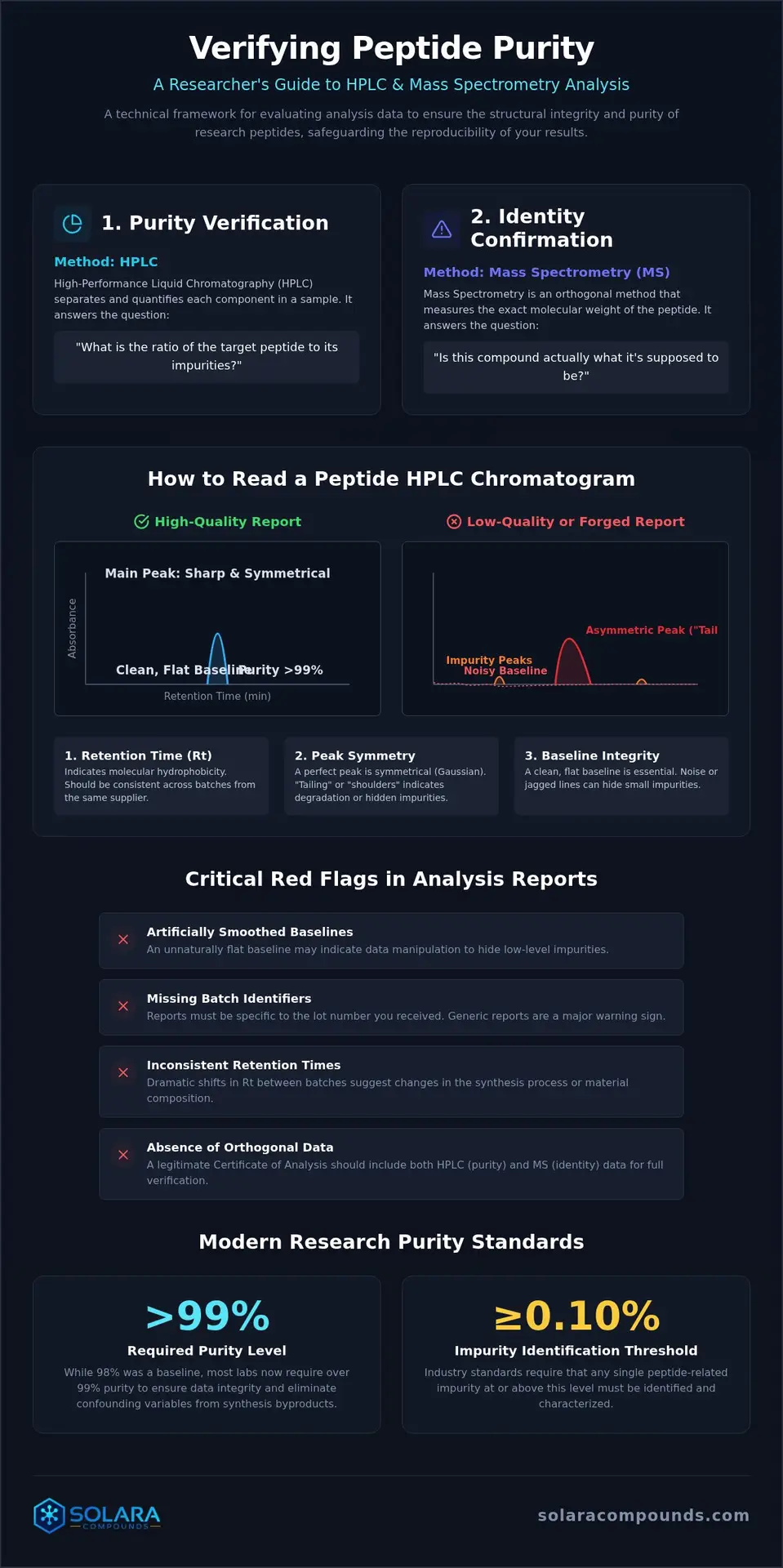
It’s vital to distinguish between purity and identity. HPLC measures the ratio of the target peptide to its impurities, but it doesn’t verify that the peptide is actually Tirzepatide or Retatrutide. For that, researchers rely on Mass Spectrometry (MS) to confirm the molecular weight. Together, these orthogonal methods provide the structural verification necessary for rigorous scientific inquiry. Without both, a researcher cannot be certain of the material’s integrity.
The Necessity of Purity in In Vitro Studies
Impurities are more than just “filler” material. They are active variables that can skew binding affinity results and lead to false positives in cellular assays. For instance, residual solvents like trifluoroacetic acid (TFA), which is frequently used during the cleavage and purification stages, can induce cytotoxic effects if not properly managed. Industry standards for 2026 emphasize that peptide-related impurities at or exceeding 0.10% must be identified and characterized. For high-stakes research involving compounds like Retatrutide, a purity level of 98% or higher is the baseline; however, many labs now require >99% to ensure the integrity of their data remains uncompromised by synthesis byproducts.
HPLC vs. Other Analytical Methods
While Thin-Layer Chromatography (TLC) and Gas Chromatography (GC) have their place in general chemistry, they lack the resolution and sensitivity required for complex peptide chains. Peptides are often large, polar, and thermally unstable, making GC impractical. Reversed-phase HPLC (RP-HPLC) has emerged as the preferred standard because it utilizes a non-polar stationary phase and a polar mobile phase to effectively separate hydrophobic peptide molecules. RP-HPLC is the standard for hydrophobic peptide analysis, offering the high resolution needed to detect even minor structural variations. This level of detail is why peptide HPLC analysis reports are indispensable for verifying that a batch meets the rigorous demands of modern laboratory environments.
How to Read a Peptide HPLC Chromatogram
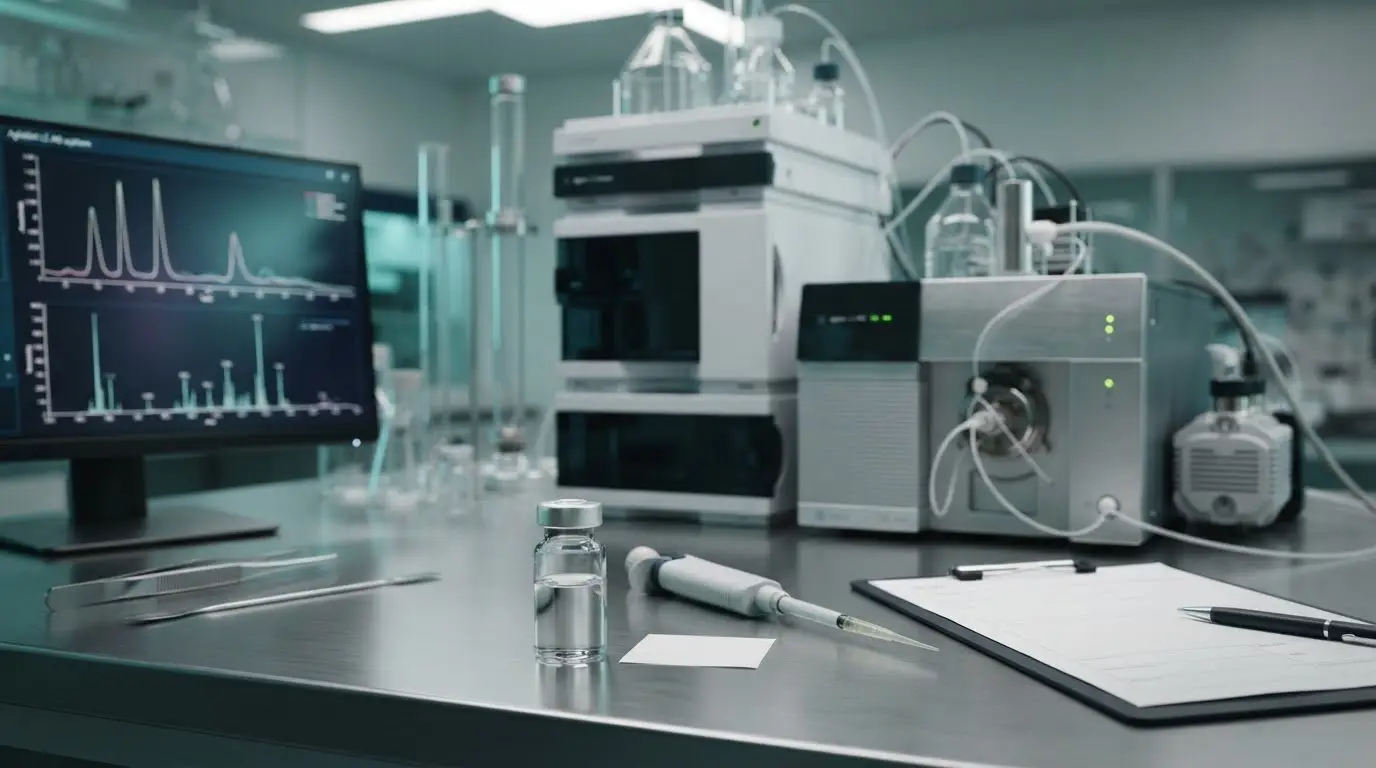
A chromatogram is a visual fingerprint of chemical integrity. The X-axis represents Retention Time (Rt), measured in minutes, while the Y-axis measures Absorbance or Intensity, typically in milli-absorbance units (mAU). When reviewing peptide HPLC analysis reports, the primary objective is to verify that the target compound elutes as a single, sharp peak. A clean baseline is equally important. Significant noise or jagged lines at the bottom of the graph can hide impurities, making it difficult to confirm the actual purity level. High-end laboratories now calibrate their systems to detect impurities at a 0.01% threshold, providing a granular view of the sample’s composition.
Step 1: Analyzing Retention Time (Rt)
Rt tells you how the peptide interacts with the stationary phase. It reflects the molecule’s hydrophobicity under specific solvent conditions. Consistency across reports is a hallmark of a reliable supplier. If the Rt shifts dramatically between batches, it may indicate a change in the synthesis process or the presence of different salts. Flow rate and solvent gradients also affect this visual output, so verify that these parameters are standardized across your comparative audits. This stability ensures that the peptide you receive today matches the performance of the peptide you used six months ago.
Step 2: Evaluating Peak Symmetry
Peak symmetry is a non-negotiable metric for quality. A perfect peak is Gaussian. When a peak appears asymmetric or has a “tail,” it often reveals peptide degradation or the presence of closely related impurities. These “shoulders” are essentially hidden contaminants that elute almost simultaneously with the target compound. Ghost peaks are another concern. These often result from solvent contamination or sample carryover from previous runs, which can skew your final purity calculation. Identifying these anomalies early prevents the risk of contaminated research data.
Step 3: Calculating Final Purity Percentages
The software produces a final percentage by integrating the Area Under the Curve (AUC). Purity is the ratio of the target peak area to the total area of all detected peaks. Don’t be misled by a single prominent peak. A thorough report must show that the integration includes all detectable peaks, even the smallest ones. For researchers who demand absolute transparency, reviewing batch-specific COAs is the only way to ensure the data hasn’t been smoothed or manipulated. This standardized approach to reading data builds a logical argument for the material’s performance in your laboratory. By critically evaluating these metrics, you transition from simple observation to expert verification.
The Role of Mass Spectrometry (MS) in Identity Verification
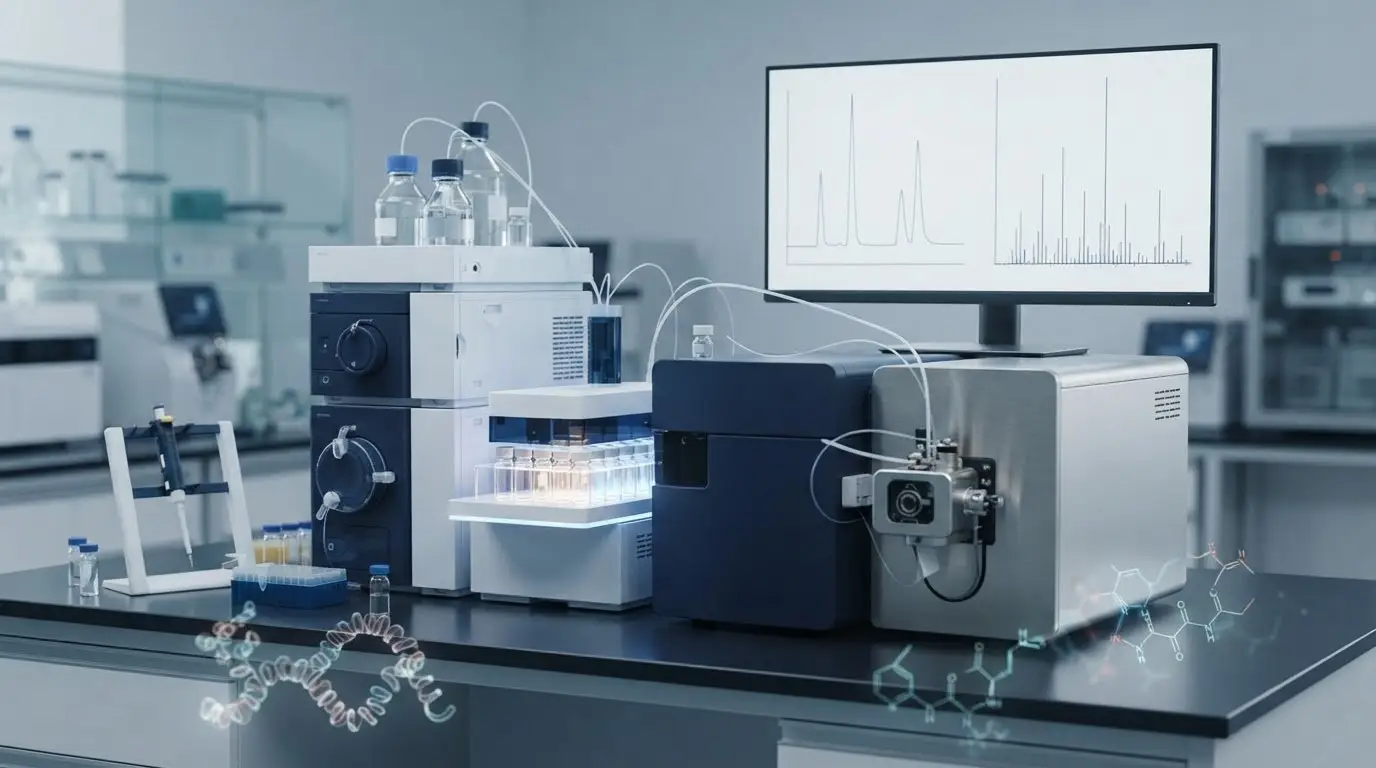
HPLC provides a measure of purity, but it remains blind to the specific chemical identity of the sample. It’s entirely possible for an impurity to elute at the same retention time as the target compound, creating a “perfect” peak that masks a structural error. This is where mass spectrometry (MS) becomes essential. By measuring the mass-to-charge ratio (m/z), MS confirms that the molecule in the vial actually matches the intended amino acid sequence. High-quality peptide HPLC analysis reports are incomplete without a corresponding MS spectrum to verify that the high-purity peak is, in fact, the correct peptide. According to regulatory standards established in 2023, at least two orthogonal procedures are required to properly identify a peptide; a single HPLC retention time is no longer considered sufficient for verification.
Matching Theoretical vs. Observed Mass
The primary goal of MS is to match the observed mass of the sample to its theoretical molecular weight. For a complex peptide like Tirzepatide, the theoretical mass is approximately 4813.1 Da. High-resolution mass spectrometry allows for a very narrow variance range, typically within 0.1% or less of the expected mass. When reviewing reports, you’ll notice multiple peaks representing different charge states, such as [M+3H]3+ or [M+4H]4+. You should also look for salt adducts. Sodium (+23 Da) or potassium (+39 Da) ions frequently attach to the peptide during the ionization process. These secondary peaks are a normal byproduct of the analysis rather than a sign of impurity, but they must be correctly identified to avoid confusion during data interpretation.
Detecting Peptide Fragments and Deletion Sequences
Mass spectrometry is uniquely capable of identifying deletion sequences where one or more amino acids weren’t successfully coupled during synthesis. These “missing” links might not significantly alter the retention time on an HPLC run, but they radically change the peptide’s biological activity. This is particularly critical for shorter sequences like GHK-Cu or BPC-157, where every residue is vital for binding affinity. By analyzing the fragmentation pattern, a lab can confirm the sequence is intact and correctly ordered. Identity verification is the second pillar of research integrity, ensuring that the structural properties of your materials align with your experimental goals. Relying on peptide HPLC analysis reports without MS data is a gamble that no serious researcher should take.
Red Flags: Identifying Low-Quality or Forged Analysis Reports
The integrity of your research depends entirely on the authenticity of the data provided by your supplier. Forged or recycled peptide HPLC analysis reports are a prevalent risk in the research chemical market, often used to mask substandard synthesis or batch-to-batch inconsistency. Detecting these forgeries requires a keen eye for technical “tells” that suggest a document has been altered or reused. Discrepancies between the vendor name and the lab equipment data are common; for instance, if the header claims the analysis was performed on a specific Agilent system but the software footer references a different manufacturer, the report is likely a composite. Precision is paramount. When a vendor provides a document where the font in the header differs from the font in the data table, it strongly suggests the report was manually edited to reflect a higher purity than the lab actually recorded.
The Danger of “Representative” COAs
A frequent tactic among less transparent vendors is the use of “representative” Certificates of Analysis. These are stock images or historical reports that do not reflect the specific batch you received. According to current 2026 industry standards, a report from 2024 is entirely irrelevant for a current batch of BPC-157 or TB-500. Peptides are sensitive to synthesis conditions and environmental factors; therefore, every batch requires its own unique verification. If a chromatogram appears blurry or pixelated, it’s often a sign that the image has been compressed and reused across multiple product pages. You should always demand batch-specific data to ensure the material in your lab matches the data on your screen.
Identifying Data Manipulation
Sophisticated forgeries often involve “manual integration” or baseline smoothing. In a legitimate run, the baseline will show a natural level of electronic noise. A perfectly flat, horizontal baseline is often a cause for suspicion, as it may indicate that the software was instructed to ignore small impurity peaks to artificially inflate the purity percentage. High-resolution analysis from reputable labs will show even trace impurities at the 0.01% threshold. To protect your research, you can verify a third-party lab’s credentials by checking their accreditation or contacting them directly to confirm a report’s serial number. For researchers who prioritize empirical data over marketing claims, sourcing from a transparent supplier that provides verifiable, third-party testing is the only way to avoid these pitfalls. This structured approach to verification ensures that your results are based on facts rather than fabricated data.
The Solara Standard: Ensuring Purity for Scientific Progress
Solara Compounds operates on the principle that transparency is the primary product. While many vendors provide generic or outdated data, we provide batch-specific peptide HPLC analysis reports for every compound in our catalog. This commitment to empirical verification ensures that your research is built on a foundation of structural integrity. We focus exclusively on high-purity materials for US-based laboratories, recognizing that the repeatability of your results depends on the chemical consistency of our peptides. Precision is our baseline. By subjecting every batch to independent laboratory audits, we eliminate the ambiguity that often plagues the research chemical market.
Our Procurement and Testing Protocol
Quality assurance begins with stringent vendor vetting and secondary verification. We don’t rely solely on manufacturer claims. Instead, we implement a protocol where every batch is subjected to third-party testing using UHPLC-HRMS. This independent audit confirms the purity and identity of compounds like Tirzepatide 10mg and Retatrutide 10mg before they enter our inventory. We also utilize advanced lyophilization standards to ensure long-term stability. This process removes moisture and residual solvents while maintaining the peptide’s bioactive structure, which prevents degradation during storage or transit. Our goal is to provide a product that remains stable and reliable from the moment it leaves our facility until it is utilized in your laboratory environment.
Securing Your Research Supply
Reliability is a prerequisite for scientific progress. Solara facilitates institutional and university procurement by providing the granular documentation necessary for internal quality audits and regulatory compliance. You can order research-grade peptides with the confidence that the material has been verified through the orthogonal methods discussed in this guide. Whether your study requires BPC-157 5mg or GHK-Cu 50mg, our focus remains on providing a consistent chemical profile that supports reproducible data. We invite you to view our latest batch-specific HPLC reports at Solara Compounds to verify the data for yourself. By prioritizing domestic quality control and absolute transparency, we act as a knowledgeable partner in your long-term research success.
The Solara standard is a commitment to excellence that bridges the gap between material science and practical application. We understand that a single vial represents hours of laboratory work and significant institutional resources. Because of this, we never compromise on the integrity of the final result. Our reports aren’t marketing tools; they’re technical records of a commitment to craftsmanship. When you source from Solara, you’re choosing a science-first organization that prioritizes empirical evidence over aesthetic appeal.
Securing the Integrity of Your Scientific Inquiry
Precision in the laboratory is a choice that begins long before the first assay is performed. By mastering the nuances of peptide HPLC analysis reports and correlating them with mass spectrometry data, you establish a rigorous defense against experimental variability. You now possess the framework to identify red flags, such as manipulated baselines, and the technical literacy to demand batch-specific verification for every compound you utilize. This commitment to transparency ensures that your research remains rooted in empirical truth rather than vendor assumptions. Repeatability is the cornerstone of science; it shouldn’t be compromised by substandard material sourcing.
Solara Compounds supports this mission by providing the exact technical data required for high-stakes scientific progress. It’s time to elevate your sourcing standards. We invite you to Browse Third-Party Tested Research Peptides and experience the difference that batch-specific HPLC/MS reports, secure domestic US shipping, and guaranteed research-grade purity can make for your study. Our protocols are designed to eliminate uncertainty so you can proceed with confidence in your results. Your focus should remain on discovery; let our data provide the stability your work deserves. We look forward to being your partner in scientific excellence.
Frequently Asked Questions
What is the difference between peptide purity and peptide content?
Peptide purity measures the percentage of the target peptide relative to other peptide-related impurities, while peptide content identifies the actual amount of peptide in the sample relative to non-peptide components like salts and water. A report might show 99% purity, but the actual peptide content is often between 70% and 85%. This distinction is critical for accurate dosing in your assays, as non-peptide mass doesn’t contribute to the biological activity.
Why does my HPLC report show multiple peaks for a single peptide?
Multiple peaks usually indicate the presence of impurities, though they can sometimes represent different conformational isomers or salt adducts. In high-quality peptide HPLC analysis reports, secondary peaks often signify truncated sequences or deletion mutations from the synthesis process. If these peaks exceed the 0.10% threshold, they must be identified to ensure they don’t interfere with your research data or binding affinity studies during the evaluation phase.
How often should a research peptide batch be re-tested for stability?
Re-testing should occur every 12 to 24 months, depending on the storage conditions and the specific amino acid sequence. Peptides containing methionine or cysteine are prone to oxidation and may require more frequent audits. Stability is significantly enhanced by lyophilization and storage at -20°C or -80°C. If you notice changes in the physical appearance or solubility of the powder, immediate re-verification is advised to protect your study.
Can HPLC analysis detect the presence of heavy metals or endotoxins?
HPLC is designed to separate organic molecules based on hydrophobicity, so it cannot detect heavy metals or endotoxins on its own. Heavy metals require Inductively Coupled Plasma Mass Spectrometry (ICP-MS), while endotoxin levels are measured using a Limulus Amebocyte Lysate (LAL) test. A standard HPLC report focuses strictly on chemical purity and cannot substitute for these specialized safety and contamination screenings required for comprehensive material verification.
What is the acceptable purity level for in vitro research peptides?
A purity level of 98% or higher is the standard benchmark for sourcing peptides for research purposes in 2026. For high-precision studies involving compounds like Retatrutide or Tirzepatide, many laboratories now mandate >99% purity. Lower purity levels increase the risk of off-target effects caused by synthesis byproducts, which can lead to false positives and compromised experimental repeatability in sensitive cellular assays and molecular docking studies.
How do I verify if an HPLC report from a vendor is authentic?
Cross-reference the batch number on your vial with the serial number on the report and contact the third-party laboratory to confirm the data’s validity. Authentic peptide HPLC analysis reports should feature high-resolution chromatograms with visible baseline noise and specific integration tables. If the report appears pixelated, lacks an analysis date, or shows a perfectly flat baseline, it’s likely a recycled or manipulated document that doesn’t reflect your material.
Does a 99% purity report mean the peptide is free of all contaminants?
No, a 99% purity rating only accounts for peptide-related impurities and does not include residual salts, moisture, or solvents. Even a high-purity batch contains counter-ions like TFA and traces of water from the lyophilization process. While the peptide itself is 99% pure, the remaining 1% represents other peptide fragments that elute at different times. It’s not an indicator of the total chemical composition of the entire lyophilized powder.