Research Articles
BPC-157 5mg Lab Use: Research Procurement Guide

A single percentage point of impurity in a peptide sequence isn’t just a minor technicality. It is a critical variable that can compromise the validity of an entire longitudinal study. For researchers focused on BPC-157 5mg laboratory use, the margin for error is nonexistent when investigating complex tissue repair mechanisms or gastric mucosal integrity. You likely recognize that inconsistent batch quality from domestic suppliers often leads to data noise that is nearly impossible to filter out during analysis. This guide serves as a comprehensive technical evaluation designed to ensure your procurement process meets the highest analytical standards, specifically targeting ≥99% purity. We will examine the nuances of interpreting HPLC and MS reports, detail the molecular pathways relevant to your study design, and outline solution-handling and storage considerations for consistent, repeatable results. Precision is the foundation of material science. By prioritizing empirical verification and batch-specific data over marketing claims, you secure the structural integrity of your research environment.
Key Takeaways
- Identify the structural specifications of the 15-amino acid pentadecapeptide and how the 5mg vial format facilitates precise, standardized research concentrations.
- Evaluate the molecular mechanisms of BPC-157, focusing on its role in upregulating VEGF expression and modulating nitric oxide pathways in research models.
- Master the interpretation of HPLC and MS reports to ensure ≥99% purity for BPC-157 5mg laboratory use, eliminating batch-to-batch variability.
- Compare laboratory solvent and buffer options, such as PBS, and understand how solution handling affects the stability of your laboratory assays.
- Implement a secure procurement strategy that leverages domestic shipping and batch-specific transparency to maintain the chemical integrity of your compounds.
The Structural Profile of BPC-157 5mg for Scientific Investigation
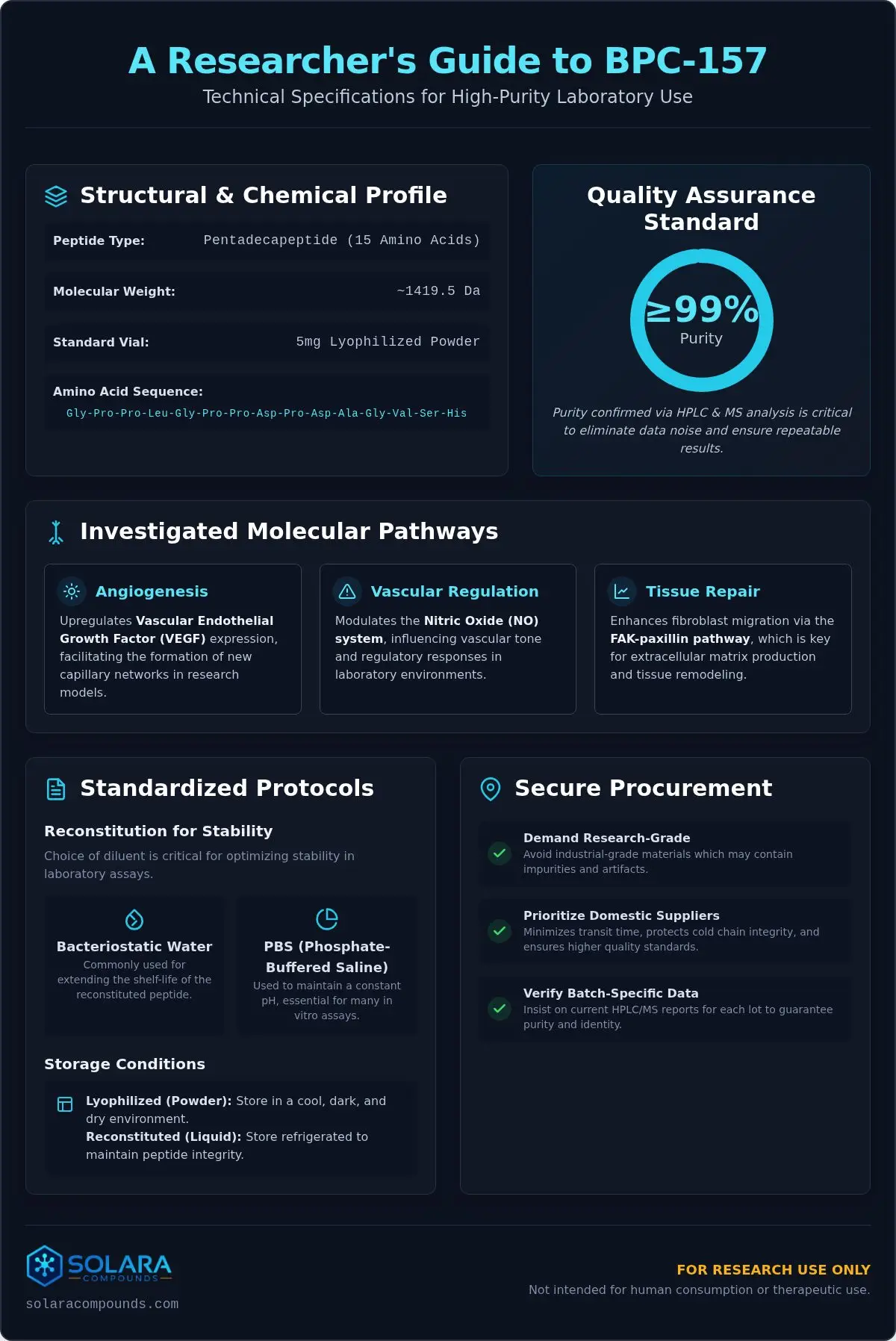
BPC-157 is a 15-amino acid pentadecapeptide. Its sequence is specifically defined as Gly-Pro-Pro-Leu-Gly-Pro-Pro-Asp-Pro-Asp-Ala-Gly-Val-Ser-His. This precise arrangement of amino acids dictates the peptide’s biological activity and chemical properties. For researchers evaluating BPC-157 5mg laboratory use, understanding the molecular weight of approximately 1419.5 Da is essential. This mass influences the compound’s solubility profile and its diffusion rates within various experimental buffers. The 5mg vial size is not an arbitrary choice. It provides a standardized quantity that allows for precise, repeatable concentration settings without the material waste often associated with larger bulk quantities. A comprehensive BPC-157 overview confirms its origins as a partial sequence of human gastric juice protein. In a controlled laboratory setting, the primary objective is maintaining this sequence’s integrity from the point of synthesis to the moment of assay application.
Chemical Stability and Lyophilization
Stability is the cornerstone of reliable data. BPC-157 is typically provided as a lyophilized powder. This freeze-drying process removes moisture through sublimation, which effectively “locks” the peptide chain into a stable state. It prevents hydrolysis, which is a common cause of peptide degradation in aqueous solutions. High-quality vials are vacuum sealed to eliminate oxygen. This step is vital because it prevents oxidative damage that could alter the peptide’s molecular identity. When inspecting a vial, look for a uniform, solid “cake.” A well-formed cake indicates the lyophilization process was executed under controlled conditions, ensuring the material has not been compromised by moisture or temperature fluctuations during transit. Consistent cake structure is a hallmark of professional chemical craftsmanship.
Research-Only Regulatory Context
Precision in sourcing is as important as precision in the laboratory. BPC-157 is strictly classified as a research chemical intended for in vitro and in vivo laboratory models. It is not for human consumption or therapeutic use. Researchers must distinguish between industrial-grade materials and high-purity research-grade compounds for BPC-157 5mg laboratory use. Industrial grades often contain residual solvents or truncated peptide sequences that can introduce significant noise into your data. Sourcing from domestic, US-based suppliers ensures that the material adheres to rigorous quality standards. Domestic procurement also minimizes the time the compound spends in transit. This is critical for maintaining the cold chain and protecting the peptide’s structural integrity. Reliability starts with the raw material. Ensuring your supply chain prioritizes empirical verification is the first step toward successful study design.
Molecular Pathways: Angiogenesis and Tissue Repair in Research Models
BPC-157 operates through several distinct intracellular signaling cascades. Its primary investigative interest lies in the upregulation of Vascular Endothelial Growth Factor (VEGF) expression. This growth factor is a critical mediator of angiogenesis. By stimulating the proliferation of endothelial cells, the peptide facilitates the formation of new capillary networks in research models. The modulation of the Nitric Oxide (NO) system is equally significant. In laboratory environments, researchers observe that BPC-157 influences NO synthesis. This is vital for maintaining vascular tone and regulating inflammatory responses. This dual action on VEGF and NO creates a robust framework for studying angiogenic and inflammatory signaling in research models.
Investigative focus often extends to collagen synthesis pathways. The peptide appears to enhance the migration and spreading of fibroblasts. These are the primary cells responsible for extracellular matrix production. This process is partly achieved through interaction with the FAK-paxillin pathway. Cellular migration assays are essential for understanding connective-tissue remodeling in experimental models. For those conducting BPC-157 5mg laboratory use, these interactions are the baseline for most musculoskeletal research protocols. Reliability in these studies depends on the structural integrity of the peptide sequence. Researchers designing multi-peptide musculoskeletal studies may also benefit from reviewing the TB-500 5mg research compound structural analysis, which details complementary actin-sequestering mechanisms relevant to connective tissue remodeling investigations.
Angiogenic Potential in In Vitro Studies
In vitro assays demonstrate that BPC-157 promotes endothelial cell tube formation. This is a fundamental step in the angiogenic process. Recent findings suggest the peptide influences the VEGFR2 internalization process. This is a key regulatory mechanism for VEGF signaling. A systematic review on BPC-157 provides detailed data on these specific molecular interactions. For researchers, these outcomes underscore the necessity of high-purity materials. Inconsistent cellular responses often stem from contaminants that interfere with these delicate signaling pathways during BPC-157 5mg laboratory use. It’s critical that the peptide remains uncompromised to ensure data validity.
Cytoprotective Mechanisms in Gastric Research
The peptide’s origins are traced back to human gastric juice. This biological context makes it a primary subject for mucosal protection studies. Research indicates that BPC-157 induces the activation of early growth response 1 (egr-1) gene expression. This gene is a master transcriptional regulator of early cellular stress and growth responses. When comparing research peptide characteristics, BPC-157 offers a different profile than GHK-Cu 50mg for research. While GHK-Cu focuses on copper-dependent remodeling, BPC-157 provides systemic stability in gastric environments. To ensure your research environment maintains these precise standards, you can procure high-purity materials through Solara Compounds. Using verified research-grade standards ensures your egr-1 activation studies yield repeatable results.
Quality Assurance: Interpreting HPLC and MS Data for Peptide Verification
Analytical verification is the only bridge between procurement and performance. For BPC-157 5mg laboratory use, relying on a supplier’s marketing claims is a significant liability. High-Performance Liquid Chromatography (HPLC) and Mass Spectrometry (MS) are the established gold standards for this verification. HPLC quantifies the purity of the sample, while MS confirms that the substance is the specific 15-amino acid chain expected. Researchers must demand batch-specific reports for every order. Generic “representative” analysis often masks significant variability between production runs, which can introduce uncontrolled variables into your study and compromise your data integrity. Laboratories working with other complex lyophilized compounds, such as research grade tirzepatide 10mg, face the same batch-to-batch consistency challenges and should apply equally rigorous HPLC and MS verification standards to every procurement decision.
Analyzing the HPLC Chromatogram
The HPLC chromatogram provides a mathematical representation of purity through the “Area %” metric. This value represents the percentage of the total area under the peaks that corresponds to the target peptide. For elite research standards, this figure must exceed 99%. A sharp, symmetrical primary peak indicates a homogeneous sample. Conversely, multiple smaller peaks suggest the presence of impurities or degradation products. Researchers who need a broader technical framework for evaluating these metrics across multiple compounds should consult this comprehensive guide on sourcing and verifying high purity research peptides, which outlines the essential verification steps that differentiate industrial-grade chemicals from precision research materials. You can find deeper insights on verifying these metrics through Independent Peptide Lab Testing: Purity & Verification. The retention time should also remain consistent across batches. This consistency ensures that the synthesis process is repeatable and stable.
Confirming Molecular Mass with MS
Mass Spectrometry confirms molecular identity by measuring the mass-to-charge ratio of the ionized peptide. For BPC-157, you should match the MS peak to the theoretical molecular weight of 1419.5 Da. Results typically show an acceptable variance of ±1 Da due to isotopic distribution. If the mass peak deviates beyond this range, the sample likely contains a truncated sequence or a synthesis byproduct. These errors frequently occur during solid-phase peptide synthesis (SPPS) when an amino acid fails to couple correctly. Detecting these errors early prevents the use of compromised material that could lead to false negatives in your cellular models.
Researchers should also examine the report for “noise” or baseline drift. Significant drift or numerous minor peaks suggest the presence of residual solvents or salts from the purification process. While these contaminants might not drastically lower the purity percentage, they can interfere with delicate biological assays. Identifying these subtle synthesis byproducts is essential for maintaining the high standards required for BPC-157 5mg laboratory use. A clean report with a flat baseline and a single dominant peak is the hallmark of professional chemical craftsmanship.
Standardized Laboratory Protocols: Solution Handling and Storage
Transitioning from a verified lyophilized powder to an active liquid assay requires meticulous handling. Even the highest purity BPC-157 5mg laboratory use standards can be compromised by poor solution-handling technique. Solution preparation should follow your laboratory’s validated protocols, beginning with a laboratory-grade solvent or buffer suited to the specific requirements of your study. For cell culture assays, phosphate-buffered saline (PBS) or other buffers are commonly used to maintain physiological pH and osmotic balance, and some preservatives can interfere with cellular readouts. Each choice carries implications for the peptide’s stability and the assay’s final outcome.
Mechanical stress is a frequent but overlooked cause of peptide denaturing. Solvent should be added gently so that it does not strike the lyophilized cake directly, and the powder should be dissolved with gentle swirling rather than shaking. Shaking creates shear forces and air bubbles that can break the fragile peptide bonds, leading to a loss of activity. Patience during this phase ensures the structural integrity of the pentadecapeptide is preserved for your research.
Molar Concentration Calculations for Assay Accuracy
Precision in concentration is the foundation of repeatable data. Stock concentration is a function of peptide mass and final solution volume, and molar concentrations should be calculated from the net peptide content and molecular weight reported on the batch-specific COA rather than from the nominal vial weight. Working solutions for cell-culture assays are then prepared by serial dilution in assay buffer. Maintaining an aseptic environment is mandatory; use sterile, laboratory-grade pipettes and tubes, and record the lot number with every preparation. For those requiring high-consistency materials for these protocols, you can order BPC-157 5mg with batch-specific verification to ensure your calculations are based on accurate mass data.
Long-Term Stability and Cold Chain Management
Peptide stability is highly temperature-dependent. In its lyophilized state, BPC-157 is stable at 4°C for several months, but for long-term storage exceeding one year, it should be kept at -20°C. Once in solution, the peptide becomes significantly less stable. Prepared solutions should be stored at 4°C and used within a use-within window validated by your laboratory. You must avoid repeated freeze-thaw cycles. Each cycle causes ice crystal formation that can physically shear the peptide chains. A robust laboratory storage checklist includes:
- Light Protection: Store vials in amber containers or dark boxes to prevent UV degradation.
- Temperature Monitoring: Use calibrated thermometers or data loggers to ensure consistent cooling.
- Desiccant Use: Keep lyophilized vials in a sealed container with desiccant to prevent moisture infiltration.
Procuring Research-Grade BPC-157 5mg from Solara Compounds
Success in the laboratory is often determined before the first assay begins. It starts with the integrity of your chemical supply chain. Solara Compounds positions itself as a specialized partner for researchers who prioritize empirical verification over marketing rhetoric. By providing BPC-157 5mg laboratory use standards that meet a rigorous ≥99% purity threshold, we eliminate the variables associated with inconsistent batch quality. Our “no-nonsense” approach to chemical craftsmanship ensures that your data remains the focus of your study. We don’t just sell compounds; we provide the analytical certainty required for high-stakes scientific investigation.
The Solara Verification Standard
Our quality control process follows a strict “claim and verify” structure. We don’t rely on outdated or representative reports. Instead, every order is accompanied by batch-specific Certificates of Analysis (COA) derived from third-party HPLC and MS testing. This transparency allows you to confirm the molecular identity and purity of your sample before it ever touches a pipette. We also offer technical support for researchers who need assistance interpreting complex chromatograms or mass spectra. If your study design involves multiple peptide pathways, you may also be interested in our GHK-Cu 50mg for Research, which maintains the same elite standards of structural integrity and optimization.
Institutional Procurement and Bulk Agreements
Repeatability is the hallmark of professional research. Maintaining a consistent supply of high-purity material is essential for longitudinal studies. Solara Compounds offers a streamlined institutional procurement process that accommodates both specialized laboratory projects and large-scale research initiatives. We provide secure online ordering with a focus on domestic efficiency. Because we ship exclusively within the United States from our Florida facility, we can maintain strict cold chain integrity. This localized logistics model prevents the degradation risks associated with international transit and customs delays. For researchers managing multi-peptide study designs, our comprehensive guide on procuring BPC-157 and TB-500 for laboratory studies outlines the technical criteria for evaluating high-purity kits against inconsistent manufacturing standards. For high-volume requirements, we offer tiered pricing structures that allow institutions to scale their research without compromising on material quality.
Choosing a supplier is a strategic decision. It’s about finding a partner who values accuracy as much as you do. Solara Compounds acts as a bridge between material science and your practical application, ensuring that every vial of BPC-157 5mg laboratory use performs exactly as the data suggests. Secure your supply chain and focus on the results that matter. You can Source BPC-157 5mg for your laboratory research today and experience the difference that analytical transparency makes in your experimental outcomes.
Advancing Research Integrity through Analytical Precision
Achieving repeatable results in peptide research requires more than just concentration; it demands structural certainty. We’ve explored how ≥99% purity standards and meticulous solution-handling protocols serve as the foundation for valid data in BPC-157 5mg laboratory use. By prioritizing batch-specific HPLC and MS verification, you eliminate the risks of synthesis byproducts and sequence truncation that often plague lower-grade materials. Maintaining this standard ensures that your investigation into angiogenic pathways and tissue repair remains uncompromised by chemical noise. Precision isn’t an option in material science; it’s the requirement for any meaningful outcome.
Solara Compounds acts as a reliable bridge between material science and your experimental objectives. We provide the empirical evidence necessary to support high-stakes study designs, ensuring every vial meets the exact specifications your research deserves. With third-party verified ≥99% purity, batch-specific reports provided for every order, and secure US-based shipping, your procurement process becomes as precise as your laboratory technique. Procure High-Purity BPC-157 5mg for Laboratory Research today. We look forward to supporting the long-term success of your scientific endeavors.
Frequently Asked Questions
Is BPC-157 5mg intended for human consumption?
No, BPC-157 5mg is strictly prohibited for human consumption or therapeutic use. It is classified exclusively as a research chemical for in vitro and in vivo laboratory models. Solara Compounds maintains a clear boundary between material science and medical application. Any use of this compound outside of a controlled laboratory environment violates safety protocols and regulatory standards. Researchers must ensure all handling and procurement adhere to these strict laboratory-only guidelines for every study.
How do I interpret the HPLC report for my BPC-157 5mg vial?
You should prioritize the “Area %” metric on the HPLC report to verify the purity of the sample. For BPC-157 5mg laboratory use, this value must reach or exceed 99%. Examine the chromatogram for a single, sharp primary peak and a flat baseline. Multiple smaller peaks or significant baseline drift indicate the presence of synthesis byproducts or residual solvents. These impurities can introduce uncontrolled variables into your research assays and compromise data integrity.
What is the theoretical molecular weight of BPC-157?
The theoretical molecular weight of BPC-157 is approximately 1419.5 Da. This value represents the combined atomic mass of the 15-amino acid sequence: Gly-Pro-Pro-Leu-Gly-Pro-Pro-Asp-Pro-Asp-Ala-Gly-Val-Ser-His. When reviewing Mass Spectrometry (MS) data, the primary peak should align closely with this figure. A variance of ±1 Da is typically acceptable due to natural isotopic distribution. Any larger deviation suggests a truncated sequence or an error in the coupling process during synthesis.
Which solvents are used to prepare BPC-157 solutions for in vitro research?
The optimal solvent depends on the specific requirements of your laboratory assay and should follow your laboratory’s validated protocols. For in vitro research, phosphate-buffered saline (PBS) or other laboratory-grade buffers are often preferred to maintain physiological pH and osmotic balance. You must select a solvent that ensures the stability of the peptide without interfering with the delicate signaling pathways of your specific cellular models. Solara Compounds does not provide preparation instructions for any use outside of laboratory research.
How long can BPC-157 5mg be stored in a laboratory freezer?
Lyophilized BPC-157 5mg can be stored in a laboratory freezer at -20°C for over one year without significant degradation. If stored at 4°C, the peptide remains stable for several months. Once in solution, its stability decreases significantly. Prepared solutions should be kept at 4°C and used within a validated window. You should avoid repeated freeze-thaw cycles, as the resulting ice crystals can physically shear the peptide chains and denature the compound.
What is the difference between BPC-157 5mg and 10mg vials in a research context?
The primary difference lies in the standardization of experimental concentrations and the reduction of material waste. The 5mg vial size is often preferred for BPC-157 5mg laboratory use because it allows researchers to prepare only the volume needed for each assay, without the risks associated with long-term storage of large solution volumes. Smaller quantities ensure that the peptide remains fresh for each assay. This format facilitates repeatable results across multiple study arms while maintaining the structural integrity of the pentadecapeptide.
Does Solara Compounds provide batch-specific COAs with every purchase?
Yes, Solara Compounds provides batch-specific Certificates of Analysis (COA) with every order. We don’t rely on generic or representative reports from past production runs. Each COA includes third-party verified HPLC and MS data to confirm ≥99% purity and molecular identity. This commitment to transparency ensures that researchers have the empirical evidence required to validate their supply chain. Our no-nonsense pride in chemical craftsmanship means every vial is backed by verifiable, batch-specific data.
What are the primary molecular pathways studied with BPC-157?
Researchers primarily study BPC-157 for its impact on the upregulation of Vascular Endothelial Growth Factor (VEGF) and the modulation of the Nitric Oxide (NO) system. These pathways are critical for investigating angiogenesis and vascular tone. Additionally, the peptide is evaluated for its role in collagen synthesis and fibroblast migration via the FAK-paxillin pathway. These molecular interactions provide the framework for understanding tissue repair and mucosal protection in various in vitro and in vivo laboratory models. Researchers expanding their tissue repair investigations may also find value in the TB-500 5mg research compound laboratory utility analysis, which examines thymosin beta-4 fragment mechanisms that operate alongside these established pathways.